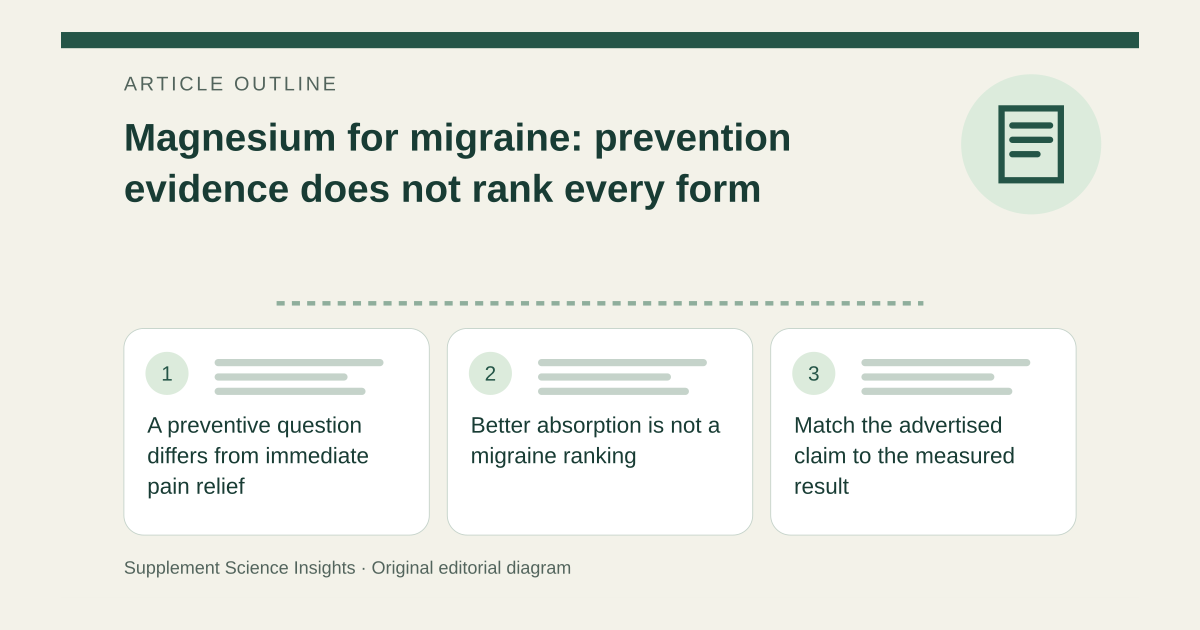
A preventive question differs from immediate pain relief
NIH ODS summarizes limited, small, short-term trials in which magnesium sometimes modestly reduced migraine frequency. This concerns prevention over time. It does not establish that a supplement will stop a headache already under way. [1]
The ODS overview also cites older professional guidance. The named trials and dated guideline discussion below add directly inspected evidence while retaining the preparation, population and outcome limits. This is not a new systematic review of every migraine treatment. [1]
Better absorption is not a migraine ranking
Citrate and some other forms have shown greater absorption than oxide in small studies. Those studies do not automatically measure migraine days, disability or treatment discontinuation. A form cannot be declared best for migraine solely because more magnesium was absorbed. [1]
ODS notes that typical studied preventive amounts exceed the adult supplemental upper limit. Kidney function, diarrhea, other medicines and the headache diagnosis therefore matter to the decision; follow a clinician’s plan rather than copying trial amounts. [1]
Match the advertised claim to the measured result
Imagine an advertisement cites a study comparing urinary magnesium after two preparations. That could inform uptake, but it supplies no direct count of migraine days. To support a migraine claim, the relevant comparison would need migraine outcomes and tolerability in an appropriate population.
| Observation | Meaning |
|---|---|
| Higher urinary magnesium | An absorption-related observation |
| Fewer migraine days | A different clinical outcome |
| Best form for everyone | Not established by either result alone |
What oral form and dose have been studied for migraine?
One randomized trial enrolled 81 adults aged 18–65 with migraine. It compared 600 mg magnesium daily, supplied as trimagnesium dicitrate, with placebo for 12 weeks after a four-week baseline period. In weeks 9–12, attack frequency fell 41.6% from baseline with magnesium and 15.8% with placebo. Some other outcomes, including attack duration and intensity, did not show a significant difference. [2][1]
Diarrhea was reported in 18.6% and gastric irritation in 4.7% of the magnesium group. A small, short trial with this preparation is not a promise for every migraine patient or every magnesium salt. The reported magnesium amount is not permission to take 600 mg of any compound or to copy the regimen: migraine protocols can exceed the usual supplemental upper limit and require clinical supervision. [2][1]
Does lower absorption make oxide ineffective for migraine?
An absorption comparison cannot settle that question. A randomized crossover study of magnesium oxide and sodium valproate enrolled 70 people, with 63 included in the analysis, and assessed migraine outcomes during eight-week treatment periods. The paper reported a similar pattern of improvement with the studied preparations. [3]
This small active-comparator study does not establish a universal best salt or prove that magnesium oxide and prescribed valproate are clinically interchangeable. Its abstract names a 500 mg magnesium-oxide preparation, but that compound amount must not be relabeled as 500 mg elemental magnesium. A clinician should interpret the full regimen and its suitability rather than replacing a medicine from an abstract comparison. [3]
Does low magnesium contribute to migraine?
NIH ODS describes associations between lower serum or tissue magnesium and migraine and discusses biological pathways involving neurotransmitter release and blood-vessel constriction. Those observations help explain why magnesium has been studied; they do not diagnose the cause of an individual headache. [1]
A preventive supplement trial and a study of magnesium status answer different questions. Even a favorable trial does not establish that every responder was deficient, that a normal serum result predicts no response, or that a new headache should be treated as a mineral problem. Keep the headache diagnosis, status assessment and treatment evidence separate. [1]
Why can guideline wording and strength differ?
The 2023 VA/DoD headache guideline gives oral magnesium for migraine prevention a weak recommendation in favor. It explicitly carries that recommendation forward from the previous guideline rather than describing it as newly reviewed. Its discussion weighs variable formulations, adverse-event information, renal function and patient preferences alongside possible benefit. [4]
The same guideline finds insufficient evidence to recommend for or against intravenous magnesium for acute headache. This is a different route and treatment purpose, not a contradiction of its oral-prevention recommendation. Check the guideline date, whether the evidence was newly reviewed, the route and the meaning of the grading label before comparing recommendations. A weak recommendation is not proof of equivalence to every standard preventive medicine. [4]
Sources for this article
- NIH ODS: Magnesium
Source consulted: 2026-09-17. This is a reference resource, not a claim that we conducted the studies or tested a product. - Peikert et al. — Oral magnesium for migraine prevention: randomized placebo-controlled study
Source consulted: 2026-10-28. This is a reference resource, not a claim that we conducted the studies or tested a product. - Karimi et al. — Magnesium oxide and sodium valproate for migraine prevention
Source consulted: 2026-10-28. This is a reference resource, not a claim that we conducted the studies or tested a product. - VA/DoD — Clinical Practice Guideline for Management of Headache (2023), recommendations 8 and 37
Source consulted: 2026-10-28. This is a reference resource, not a claim that we conducted the studies or tested a product.