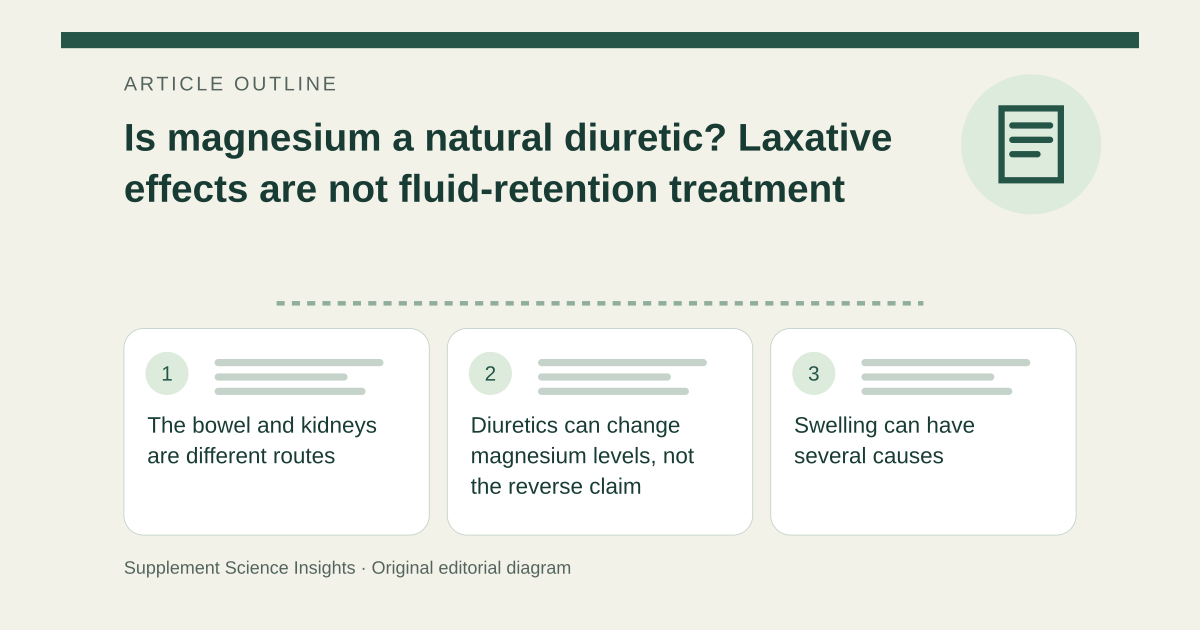
The bowel and kidneys are different routes
Some magnesium products act as laxatives and can cause diarrhea. That does not demonstrate useful removal of excess tissue fluid or establish treatment of edema. Fluid lost through diarrhea can instead contribute to dehydration. [1]
Diuretics can change magnesium levels, not the reverse claim
NIH explains that loop and thiazide diuretics can increase urinary magnesium losses, while some potassium-sparing drugs reduce excretion. Those interactions do not mean that magnesium itself functions as an interchangeable diuretic. [1]
Swelling can have several causes
NHS describes prolonged standing or sitting, medicines, venous problems and heart, liver or kidney disease among possibilities. The right response depends on the cause; a supplement cannot be selected simply because a leg looks swollen. [2]
Kidney concerns require particular care
Impaired kidneys can reduce magnesium clearance and increase toxicity risk from supplements or medicines. Using more magnesium to try to force fluid removal can therefore be especially inappropriate when kidney disease is part of the problem. [1]
Do not replace a prescribed fluid plan
Imagine someone with ankle swelling stops a prescribed water pill and starts magnesium citrate. The bowel response would not establish that the underlying edema is controlled. Seek urgent advice for sudden, painful or unexplained one-sided swelling, and emergency help when swelling accompanies chest pain or breathlessness. [2][1]
| Observation | Meaning |
|---|---|
| More bowel movements | Laxative response |
| Diuretic changes magnesium level | A medicine effect on the mineral |
| Swollen ankles | Cause needs assessment |
| Kidney impairment | Raises excess-magnesium concern |
Sources for this article
- Magnesium - Health Professional Fact Sheet
Source consulted: 2026-09-21. This is a reference resource, not a claim that we conducted the studies or tested a product. - Swollen ankles, feet and legs (oedema) - NHS
Source consulted: 2026-09-21. This is a reference resource, not a claim that we conducted the studies or tested a product.