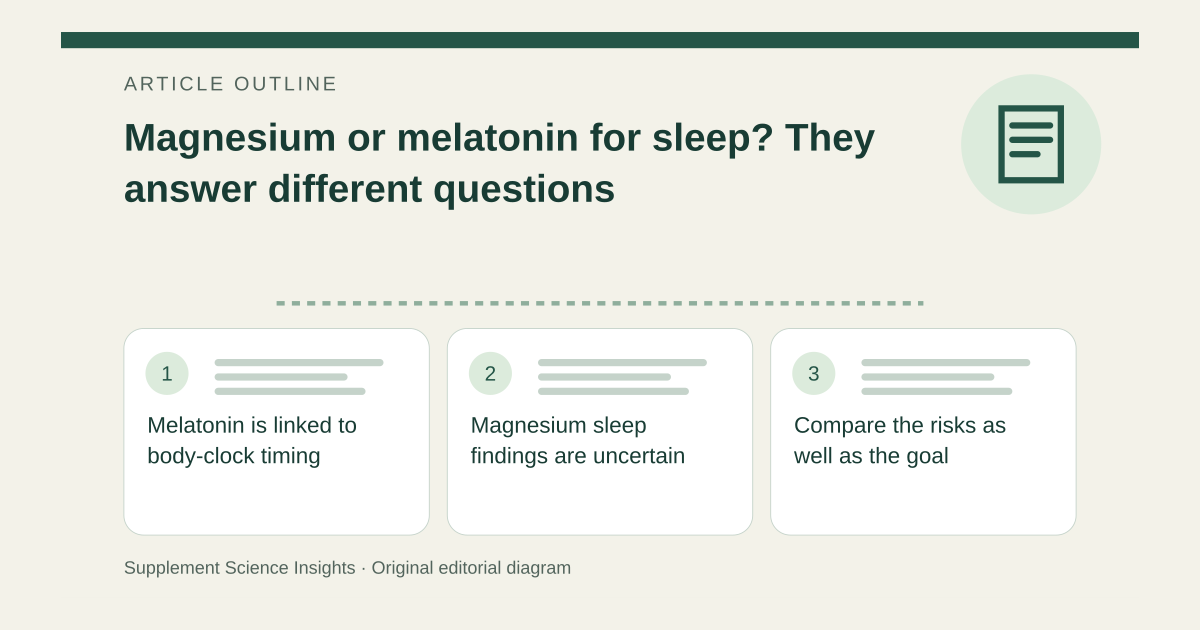
Melatonin is linked to body-clock timing
NCCIH describes possible usefulness for jet lag and delayed sleep-wake timing, alongside other specific settings. That does not establish routine melatonin as the preferred treatment for chronic insomnia. Formulation, timing and the reason for use remain relevant. [1]
Magnesium sleep findings are uncertain
NCCIH summarizes a small low-quality evidence base and inconsistent broader findings. A normal role in nervous-system function does not prove that an extra magnesium serving improves sleep in a person with adequate intake. The evidence does not provide a reliable best-form ranking. [2]
Compare the risks as well as the goal
Magnesium can cause diarrhea and carries greater toxicity risk with kidney impairment. Melatonin can cause daytime drowsiness and has medicine interactions, while long-term safety remains incompletely understood. Natural origin is not a shared safety guarantee. [3][1][4]
Taking both is a separate question
Separate evidence for two ingredients does not establish that the combination is more effective or appropriate. A multi-ingredient sleep product may contain other sedating components. Review the full formula and medicines with a pharmacist before stacking products rather than assuming a spacing rule makes the combination safe. [4][3]
Match the sleep complaint before choosing
Imagine one person struggles after crossing time zones and another has months of insomnia. They need different assessments. NCCIH identifies cognitive behavioural therapy for insomnia as the most strongly recommended insomnia treatment; repeated supplement changes should not substitute for evaluating a persistent problem. [1][2]
| Situation | Relevant distinction |
|---|---|
| Jet lag | Timing problem and melatonin-specific evidence |
| Persistent insomnia | Assessment and CBT-I |
| Considering a combination | Whole formula, medicines and safety |
Sources for this article
- Melatonin: What You Need To Know | NCCIH
Source consulted: 2026-09-21. This is a reference resource, not a claim that we conducted the studies or tested a product. - Sleep Disorders and Complementary Health Approaches: Usefulness and Safety | NCCIH
Source consulted: 2026-09-21. This is a reference resource, not a claim that we conducted the studies or tested a product. - Magnesium - Health Professional Fact Sheet
Source consulted: 2026-09-21. This is a reference resource, not a claim that we conducted the studies or tested a product. - Taking melatonin with other medicines and herbal supplements - NHS
Source consulted: 2026-09-21. This is a reference resource, not a claim that we conducted the studies or tested a product.