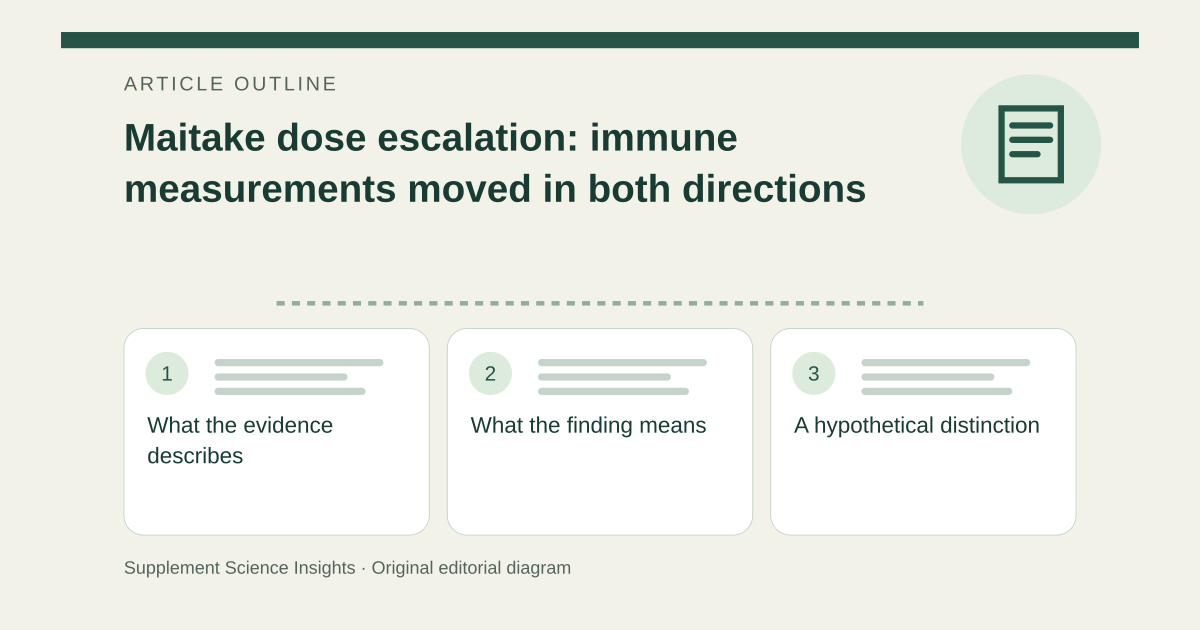
What the evidence describes
Thirty-four postmenopausal breast-cancer patients without evident disease after initial treatment entered five sequential dose groups. They took a maitake polysaccharide extract for three weeks; safety and tolerability were primary endpoints. [1]
Some immune measurements increased and others decreased, with several nonmonotonic dose-response patterns. Two participants withdrew with possibly related mild adverse effects. There was no placebo group establishing a cancer-treatment benefit. [1]
What the finding means
Immune-cell changes are not evidence of longer survival, prevention of recurrence or fewer infections. MSK and NIH-associated grants supported the work; conflicts were not established from the retrieved text. Use during cancer care requires discussion with the treating team. [1]
A hypothetical distinction
Imagine a middle dose raises one laboratory measure but lowers another. Calling the whole result an immune boost discards that complexity.
| Detail | Interpretation |
|---|---|
| Finding | Preserve the measured or observed outcome |
| Context | Species, preparation or setting matters |
| Limit | No universal safety or benefit guarantee |
Sources for this article
- A phase I/II trial of a polysaccharide extract from Grifola frondosa (Maitake mushroom) in breast cancer patients: immunological effects - PMC
Source consulted: 2026-09-19. This is a reference resource, not a claim that we conducted the studies or tested a product.