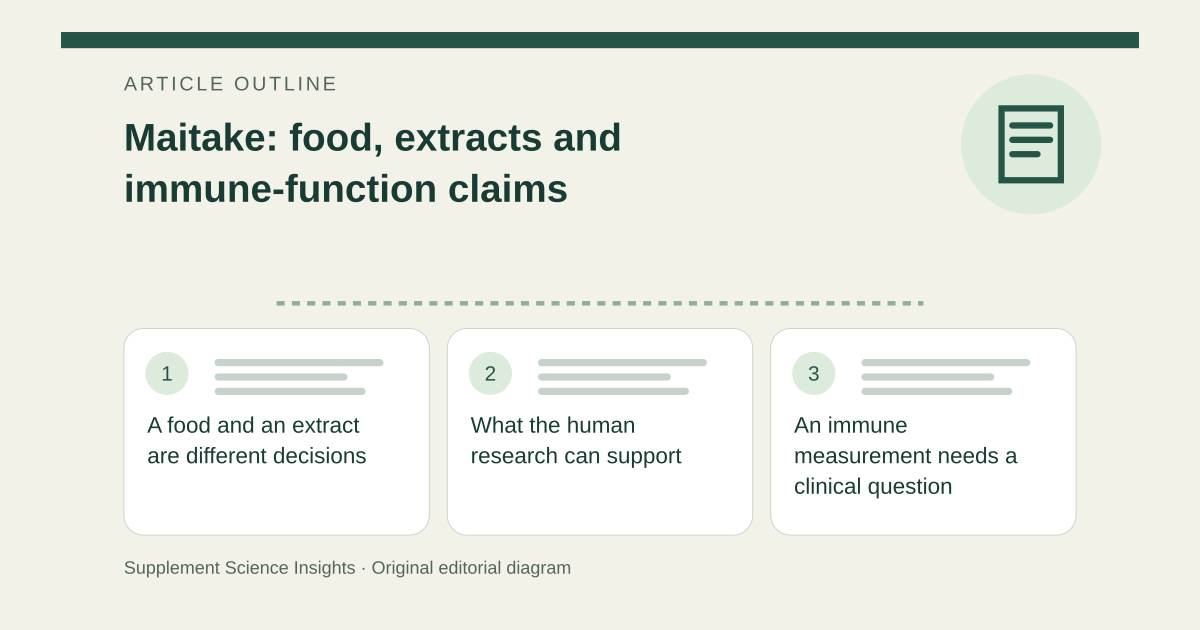
A food and an extract are different decisions
Maitake is an edible mushroom. MSK describes supplements containing extracts and polysaccharide preparations, including products marketed around immune function. A meal and a concentrated preparation may share a source ingredient, but that does not make a study of one direct evidence for the other. [1]
What the human research can support
MSK characterizes the clinical data as limited. It describes small studies involving immune measurements and selected cancer-care populations, alongside substantial preclinical research. This does not establish an over-the-counter maitake product as a cancer treatment or a way for a generally healthy person to avoid infections. [1]
An immune measurement needs a clinical question
The phrase “supports immunity” is too broad to evaluate by itself. Ask whether the study measured a cell count, a laboratory response, symptoms, infections or another outcome. Then ask why that outcome matters for the person considering the product.
For example, a hypothetical study could find that a particular immune-cell measurement changed after an extract. The result would answer a question about that measurement. To establish fewer infections, the study would also need to observe infections with an appropriate comparison. Replacing the measured outcome with the benefit a buyer hopes for is an extra inference, not a finding.
| Information presented | What it establishes | What remains unanswered |
|---|---|---|
| A named extract is studied | Evidence about that preparation | Equivalence to another extract |
| An immune marker changes | A measured biological response | Fewer infections |
| A food contains maitake | A culinary ingredient | The effect of a concentrated supplement |
Why formulation details matter
When a product invokes a named mushroom fraction, check whether its cited paper actually studied that fraction and the same route of administration. A similar word in the product description is not enough to establish a match. If the paper studied a combination, the result belongs to that combination.
A useful comparison records what is known and leaves the other cells blank. Preparation, study population and outcome should be identifiable before price or capsule count enters the decision. This approach may produce no recommended product, which is preferable to treating an unverified link as established.
Blood sugar and warfarin deserve attention
MSK warns that maitake may add to the effects of glucose-lowering medicines. It also describes a case of increased INR during warfarin use and reports asymptomatic eosinophilia in clinical research. Discuss extracts with the prescribing clinician; use during cancer treatment belongs in the treating team’s medication review. These observations do not establish a frequency of side effects for all preparations. [1]
Sources for this article
- Memorial Sloan Kettering — Maitake
Source consulted: 2026-09-17. This is a reference resource, not a claim that we conducted the studies or tested a product.