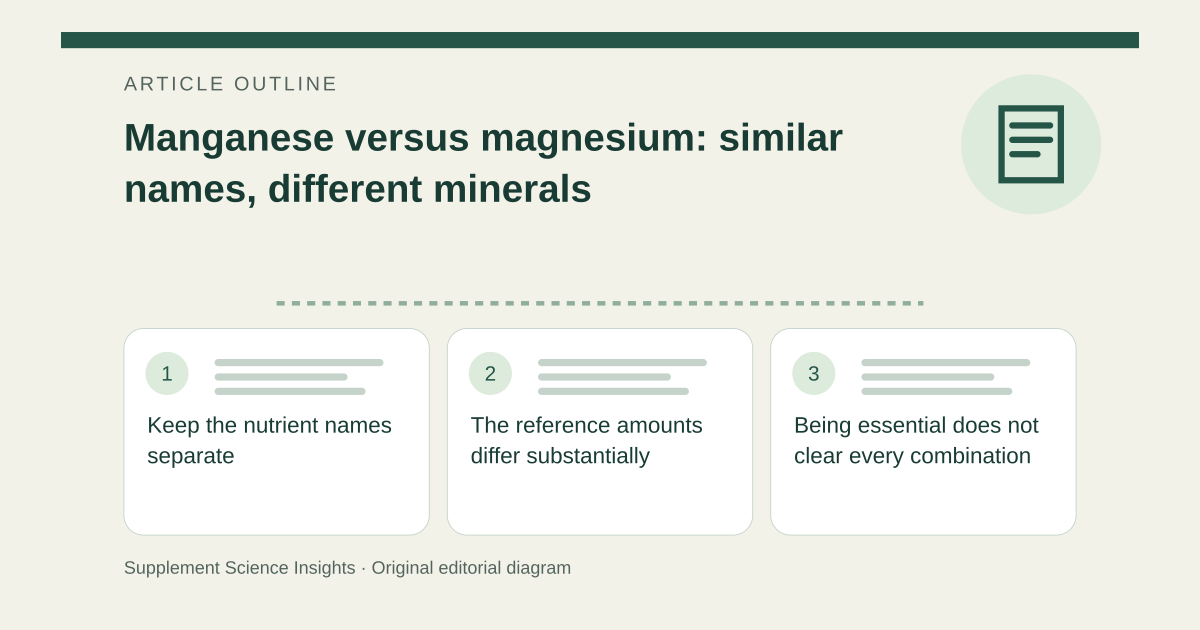
Keep the nutrient names separate
Manganese and magnesium are different chemical elements. Manganese contributes to enzymes involved in metabolism and antioxidant defense. Magnesium also has many normal physiological roles, but it cannot be substituted for manganese simply because a label or search result looks similar. [1][2]
The distinction is particularly important when transcribing a product list. A shortened or misspelled name can turn an accurate amount into a record for the wrong nutrient. [1][2]
The reference amounts differ substantially
ODS gives adult manganese Adequate Intakes of 2.3 mg for men and 1.8 mg for women. For magnesium, adult RDAs range from 310 to 420 mg depending on age and sex, apart from pregnancy-specific values. These are total-intake references, not default supplemental doses. [1][2]
The different scale reflects different nutritional requirements. It is not evidence that magnesium is more important or that manganese should be increased to match it. An AI also has a different evidence basis from an RDA. [1][2]
Being essential does not clear every combination
A diet can supply both minerals, but that does not establish a need for two concentrated supplements. Assess each ingredient against the actual nutritional or clinical purpose and keep the complete product amounts visible. [1][2]
The cited intake tables do not establish a universal combination ratio, a compatibility guarantee for every dose, or a timing rule. They establish that these are separate nutrients with separate reference values. [1][2]
A copied dose can become a major identity error
Imagine a list records 200 mg magnesium, then accidentally changes the nutrient name to manganese. Keeping the number while changing the element does not preserve the meaning. Verify the full nutrient name before using any amount.
| Detail | Interpretation |
|---|---|
| Manganese adult AI | 1.8–2.3 mg/day |
| Magnesium adult RDA | 310–420 mg/day |
| Dose substitution | Not valid |
Sources for this article
- NIH ODS: Manganese — Health Professional Fact Sheet
Source consulted: 2026-09-17. This is a reference resource, not a claim that we conducted the studies or tested a product. - NIH ODS: Magnesium — Health Professional Fact Sheet
Source consulted: 2026-09-17. This is a reference resource, not a claim that we conducted the studies or tested a product.