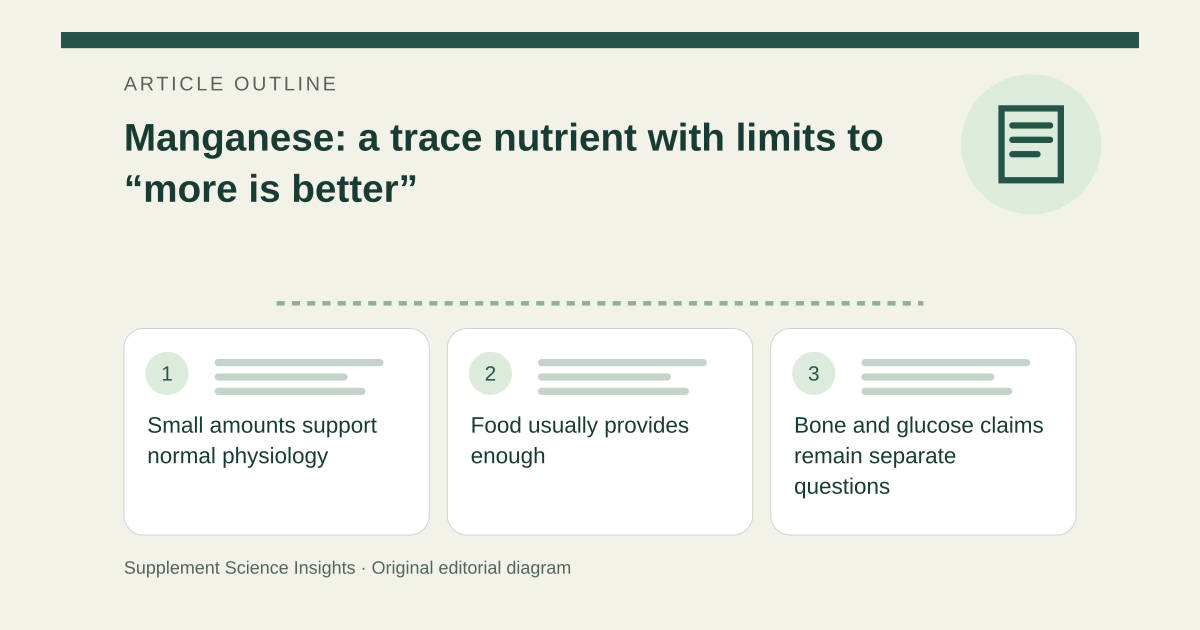
Small amounts support normal physiology
Manganese supports enzymes involved in metabolism and antioxidant defense. It also contributes to bone formation and other normal functions. It is a different mineral from magnesium, despite the similar names; the amounts used in nutritional reference values differ substantially. [1]
An enzyme's need for manganese does not prove that supplying more accelerates the process or improves a symptom. That distinction matters when an energy, joint or blood-sugar product borrows a biochemical explanation as evidence of benefit. [1]
Food usually provides enough
Whole grains, nuts, legumes, leafy vegetables, shellfish and tea can supply manganese. U.S. adequate intakes for adults are 2.3 mg daily for men and 1.8 mg for women. Most people in the United States obtain enough from food, and deficiency is very rare. [2]
An adequate intake is a population-based nutritional reference, not a prescription for the amount in a capsule. Food, beverages and any existing multivitamin count toward the total. A food diary can help identify the pattern without treating every day as an exact laboratory measurement. [2]
Bone and glucose claims remain separate questions
Manganese is needed for healthy bone formation, but its usefulness as an additional bone-health supplement is not established simply by that role. Research on manganese measures and diabetes also does not establish a routine treatment. [1]
When a joint formula contains several ingredients, an improvement in a study of that formula cannot identify manganese as the active component. Look for whether manganese was tested separately, what participants already consumed and whether the outcome was pain, function, a laboratory marker or something else. [1]
Excess exposure can affect the nervous system
Excess manganese can be neurotoxic. Occupational inhalation is a different exposure route from ordinary foods, but it is a reminder that essential minerals are not harmless at every exposure. NIH lists an adult upper limit of 11 mg per day from food, beverages and supplements. [2][1]
That ceiling is not an intake goal. Liver disease can increase susceptibility because manganese elimination is impaired. A clinician should assess unusual exposure or neurological symptoms; supplement arithmetic cannot distinguish toxicity from other causes. [2][1]
Do not confuse manganese with magnesium
Imagine a multivitamin declares 2 mg manganese and a joint product declares 3 mg manganese per daily serving. Their fictional supplemental subtotal is 5 mg, before food and beverages. A separate 200 mg magnesium entry is a different nutrient and should not be added to that column.
Keep full names and units in the worksheet. An abbreviation such as “Mn” can be useful only if its identity is clear. The calculation is an inventory, not a claim that the combination is needed or safe for a particular person.
| Entry | Manganese subtotal |
|---|---|
| Multivitamin | 2 mg |
| Joint formula | 3 mg |
| Combined; food excluded | 5 mg |
| Separate magnesium entry | Do not add |
A precise label is more useful than a broad promise
Record manganese separately from magnesium and from the total blend weight. If a product's argument is only that manganese participates in normal metabolism, the clinical benefit question remains unanswered.
This reference uses NIH summaries rather than an independent appraisal of every original trial. It supports accurate comparison and exposure records; it does not endorse a joint formula, treat diabetes or establish an individual upper limit.
Sources for this article
- NIH ODS — Manganese, professional fact sheet
Source consulted: 2026-09-17. This is a reference resource, not a claim that we conducted the studies or tested a product. - NIH ODS — Manganese, consumer fact sheet
Source consulted: 2026-09-17. This is a reference resource, not a claim that we conducted the studies or tested a product.