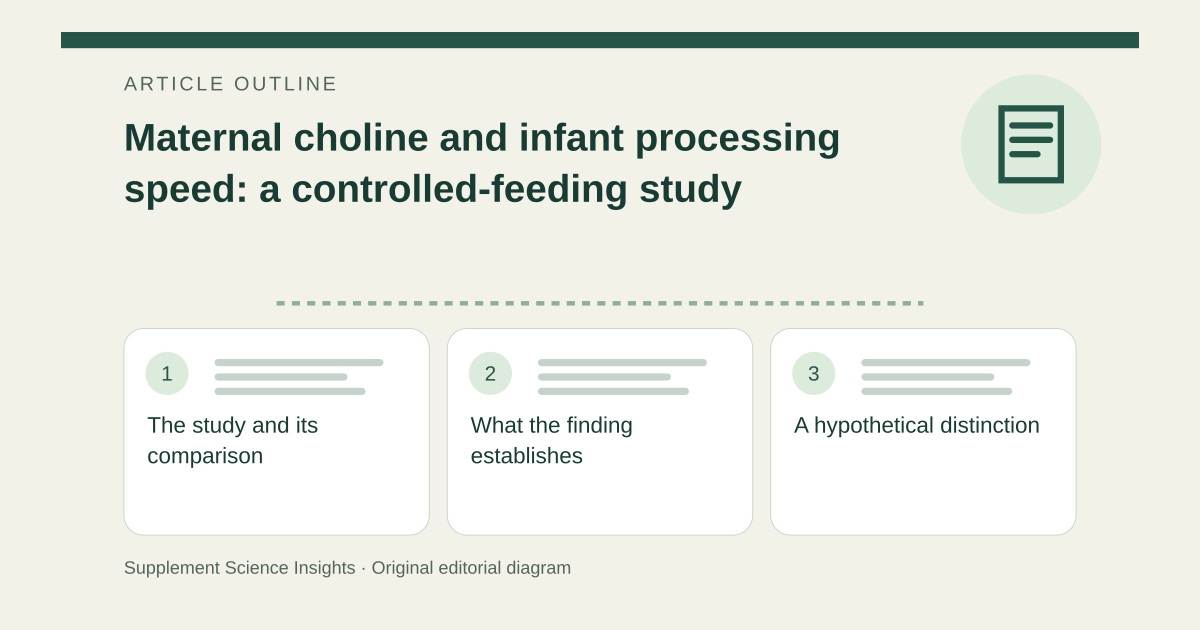
The study and its comparison
Twenty-six women entering the third trimester were randomized to controlled daily choline intakes of 480 or 930 milligrams until delivery. Researchers assessed twenty-four infants at four ages during their first thirteen months. [1]
Average reaction time across those assessments was faster among infants in the higher-intake group. The comparison was between two choline intakes, not supplementation against complete choline absence. [1]
What the finding establishes
The small sample and selected processing-speed outcome do not establish broad or lifelong cognitive benefit. Funding included the Egg Nutrition Center, Beef Checkoff, USDA and academic sources. The authors declared no conflicts and stated that funders did not direct study conduct or interpretation. This feeding experiment cannot establish the effects of every choline-containing product. [1]
A hypothetical distinction
Imagine a higher intake changes one infant test. School performance years later remains an unmeasured outcome.
| Detail | Interpretation |
|---|---|
| Measured outcome | Keep the endpoint specific |
| Study preparation | Not every retail product |
| Remaining uncertainty | Not resolved by a mechanism |
Sources for this article
- Maternal choline supplementation during the third trimester of pregnancy improves infant information processing speed: a randomized, double-blind, controlled feeding study.
Source consulted: 2026-09-19. This is a reference resource, not a claim that we conducted the studies or tested a product.