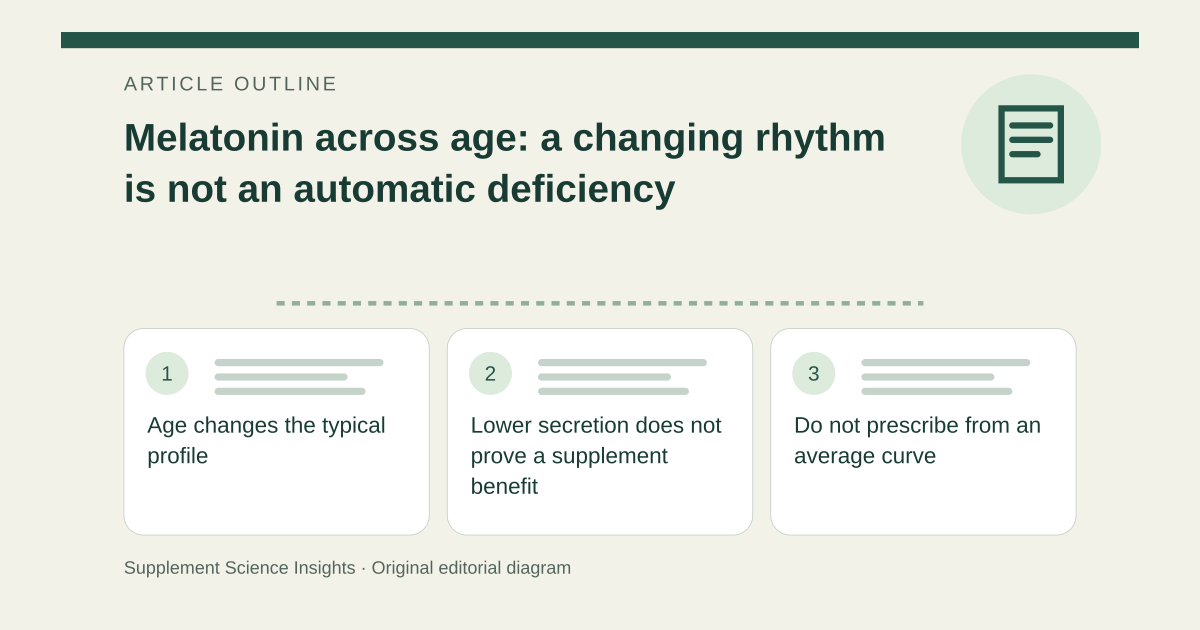
Age changes the typical profile
Endotext describes the emergence of a daily rhythm in early infancy, higher levels during childhood and lower concentrations later in life. The account describes broad patterns rather than a personal target value. [1]
Individuals differ, and a measurement also depends on when and how it is collected. Age alone cannot provide the value that would have been measured under controlled conditions. [1]
Lower secretion does not prove a supplement benefit
A biological change with aging is not itself a trial demonstrating that supplementation improves sleep, cognition or longevity. Each proposed outcome needs evidence in the relevant population. [1]
Avoid treating a lower average concentration as a diagnosis from which a dose follows automatically. Persistent sleep problems need assessment of their actual causes and context. [1]
Do not prescribe from an average curve
Imagine two older adults have different sleep problems. Their shared age does not establish that the same melatonin regimen addresses either cause.
| Detail | Interpretation |
|---|---|
| Age pattern | Population observation |
| Individual status | Needs appropriate assessment |
| Treatment benefit | Separate clinical evidence |
Sources for this article
- Physiology of the Pineal Gland and Melatonin - Endotext - NCBI Bookshelf
Source consulted: 2026-09-18. This is a reference resource, not a claim that we conducted the studies or tested a product.