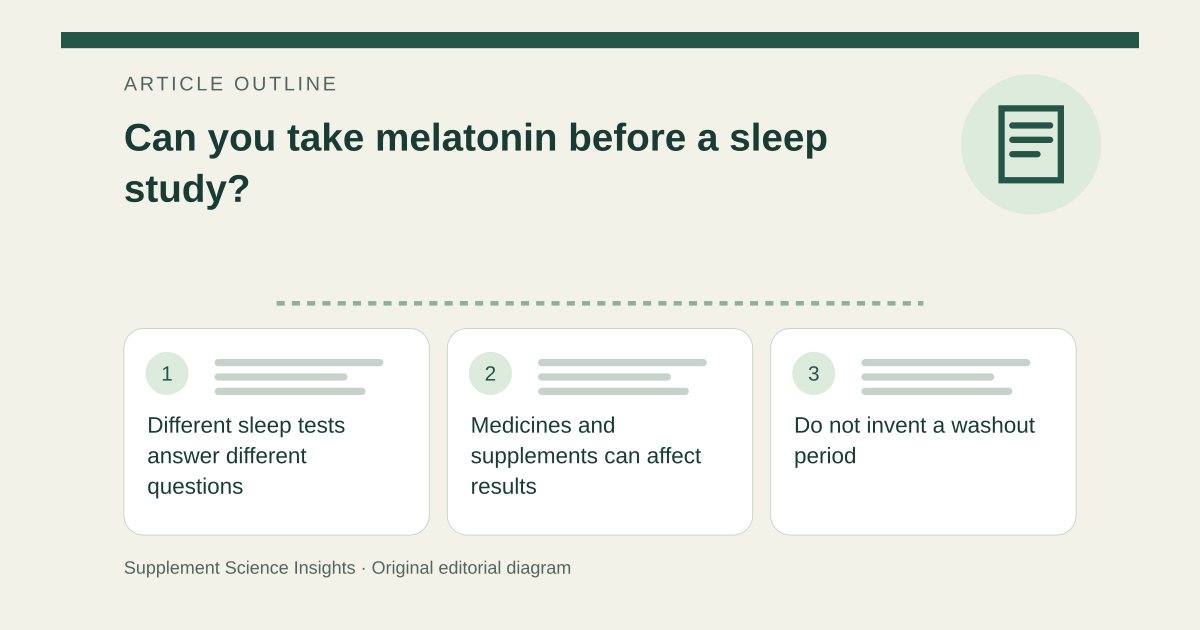
Different sleep tests answer different questions
An overnight polysomnogram records sleep and body activity, while daytime tests may measure sleep latency or the ability to stay awake. An instruction appropriate for one test may not fit another. Follow the preparation sheet for your actual appointment. [1]
Medicines and supplements can affect results
Johns Hopkins advises disclosing prescription medicines, over-the-counter products, herbs and alcohol because they may alter the measurements. Its preparation guidance says sedatives require provider direction. Melatonin use belongs in that discussion even if you bought it as a supplement. [1][2]
Do not invent a washout period
The reviewed patient page does not supply one universal melatonin-free interval. Formulations and personal circumstances differ. Contact the laboratory in advance and ask whether to continue the usual product, adjust it or avoid it, rather than using advice for someone else’s study. [1][3]
Tell the team if you already took it
Imagine you take melatonin out of habit before arriving. Report the exact product, amount and time. The team can decide how to proceed and interpret the test; concealing it or taking more to force sleep would make the information less useful. [1][2]
| Information | Why it matters |
|---|---|
| Test type | Determines preparation |
| Usual melatonin | Part of the medicine history |
| Laboratory instructions | Individual continue-or-hold plan |
| Dose already taken | Disclose accurately |
Sources for this article
- Sleep Study - Johns Hopkins Medicine
Source consulted: 2026-09-21. This is a reference resource, not a claim that we conducted the studies or tested a product. - Melatonin: What You Need To Know | NCCIH
Source consulted: 2026-09-21. This is a reference resource, not a claim that we conducted the studies or tested a product. - How and when to take melatonin - NHS
Source consulted: 2026-09-21. This is a reference resource, not a claim that we conducted the studies or tested a product.