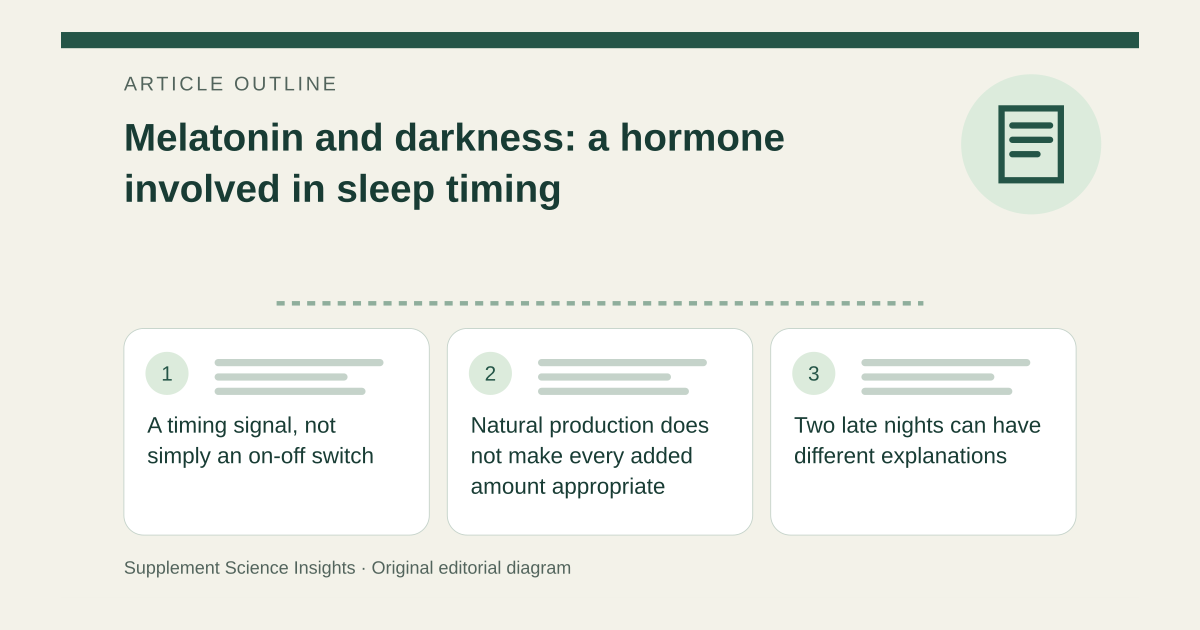
A timing signal, not simply an on-off switch
Melatonin is a hormone produced by the brain in response to darkness. NCCIH describes its role in circadian rhythms, the roughly 24-hour timing system, as well as in sleep. [1]
Light exposure at night can inhibit melatonin production. This connects the hormone to environmental timing, but it does not mean that a single melatonin concentration determines every reason a person cannot sleep. [1]
Natural production does not make every added amount appropriate
Melatonin supplements are most often made synthetically, although other sources are possible. The product is an additional exposure; the presence of the same hormone in the body does not establish that any supplemental amount is needed or safe. [1]
NCCIH distinguishes particular sleep conditions when discussing benefits. A body-clock explanation alone cannot identify whether a person has insomnia, a timing disorder or another problem. [1]
Two late nights can have different explanations
Imagine one person stays awake after evening light exposure and another remains awake because of pain. Both report a late bedtime, but that observation does not prove the same mechanism or treatment need.
A useful sleep history records timing and circumstances instead of assuming that any difficulty sleeping means the body lacks melatonin.
| Detail | Meaning |
|---|---|
| The body makes melatonin | Normal physiology |
| Night light can inhibit production | An environmental influence |
| An extra dose is needed | Does not follow automatically |
A hormone label is not a safety assessment
NCCIH notes gaps in long-term supplement safety and advises particular care with medicines and certain health conditions. Natural is therefore not a substitute for assessing the actual use. [1]
This page explains the physiological role. It does not provide a personal dose, infer a hormone deficiency or claim that a supplement corrects every sleep problem. [1]
Sources for this article
- NCCIH: Melatonin—What You Need To Know
Source consulted: 2026-09-17. This is a reference resource, not a claim that we conducted the studies or tested a product.