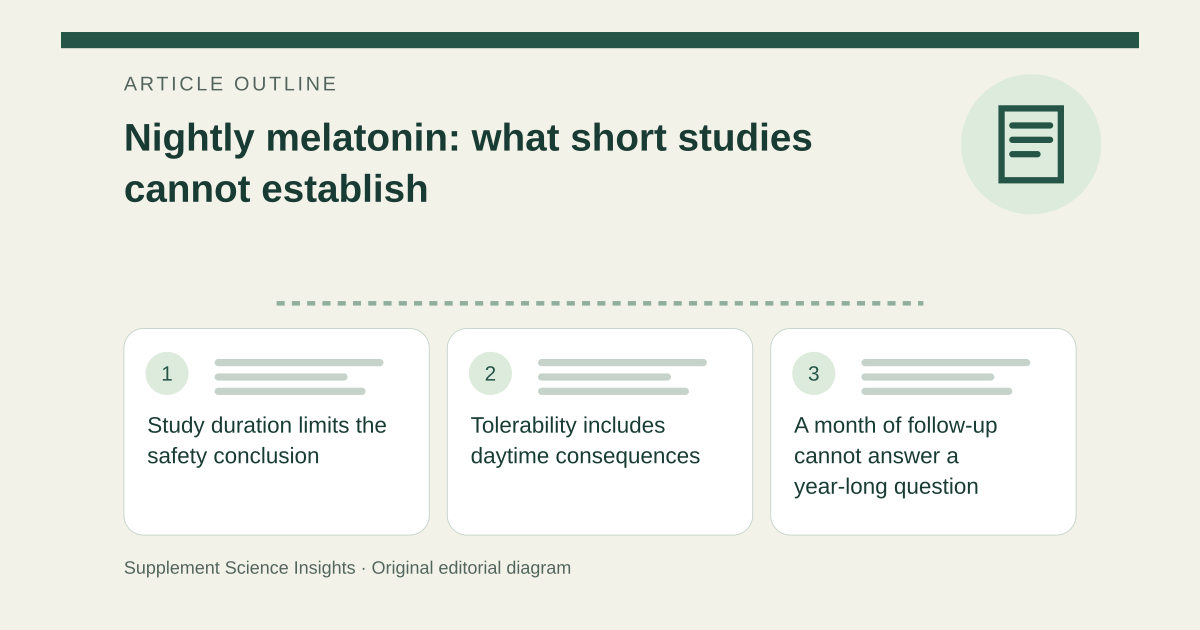
Study duration limits the safety conclusion
NCCIH describes short-term use as appearing safe for most people while noting a lack of information about long-term supplementation. A brief trial and years of nightly exposure are different questions. [1]
A statement that only mild effects were observed during short studies does not demonstrate that all longer-term outcomes were measured or excluded. Absence of a reported event is not the same as a complete long-term safety assessment. [1]
Tolerability includes daytime consequences
The source lists headache, dizziness, nausea and sleepiness among reported effects. Melatonin may remain active longer in older adults and contribute to daytime drowsiness. [1]
Medication use and conditions such as epilepsy add context. A person’s experience over several nights cannot substitute for reviewing ongoing need, symptoms and possible interactions. [1]
A month of follow-up cannot answer a year-long question
Imagine a study follows participants for four weeks without a particular adverse effect. That supports a statement about the observed four-week period, not a guarantee for twelve months.
The same reasoning applies when someone reports that a supplement has worked so far: the experience is relevant but does not settle every future risk.
| Detail | Meaning |
|---|---|
| Four-week observation | Evidence for that period |
| One-year safety claim | Requires longer relevant evidence |
| Works so far | Useful experience, not universal assurance |
A recurring sleep problem deserves a recurring assessment
Persistent reliance on a supplement should not prevent investigation of the sleep problem itself. Evidence for one timing disorder is not automatically evidence for all chronic insomnia. [1]
This page does not invent a maximum duration, a taper or a universal nightly regimen. It preserves the distinction between short-term findings and the questions that remain unresolved. [1]
Sources for this article
- NCCIH: Melatonin—What You Need To Know
Source consulted: 2026-09-17. This is a reference resource, not a claim that we conducted the studies or tested a product.