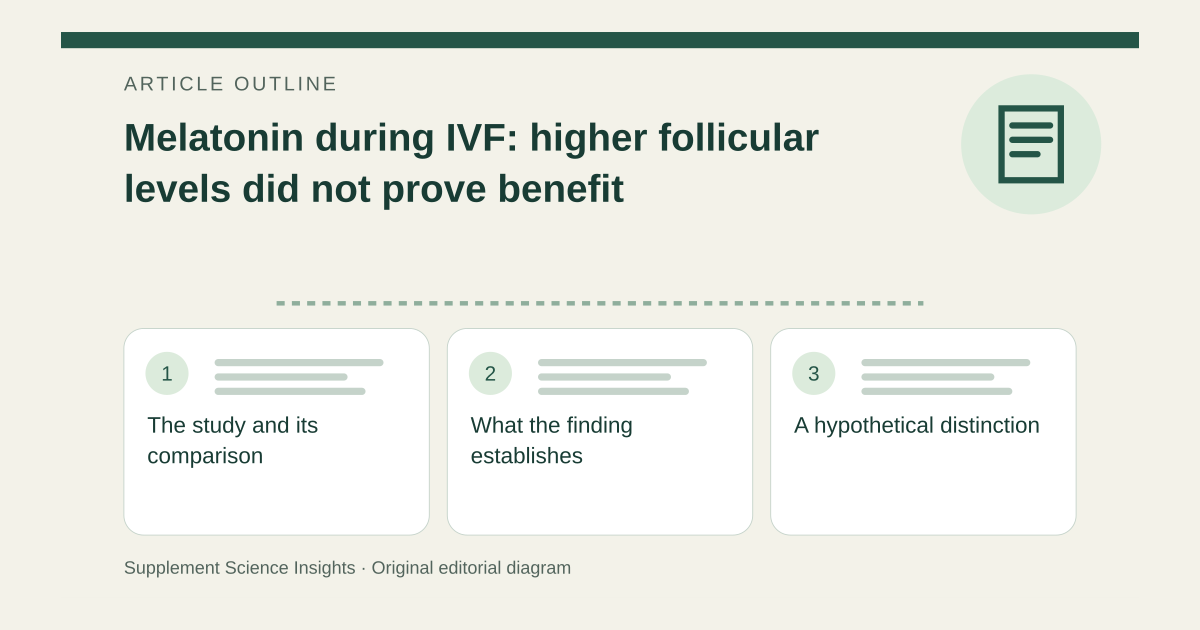
The study and its comparison
One hundred sixty women having their first IVF or ICSI cycle were randomized to placebo or one of three melatonin regimens during ovarian stimulation. Clinical pregnancy was the primary outcome. [1]
Pregnancy and live-birth rates did not significantly differ among groups. Egg and embryo measures also did not improve, despite about ninefold higher follicular-fluid melatonin in the highest-dose group. [1]
What the finding establishes
The investigators emphasized limited statistical power. A null pilot cannot establish equivalence, but the concentration rise is not proof of reproductive benefit either. Funding and conflicts were not established from the abstract. This study does not provide a personal fertility-treatment dose or support replacing established care. [1]
A hypothetical distinction
Imagine more of a compound reaches follicular fluid while pregnancy rates remain uncertain. Exposure and successful treatment are different endpoints.
| Detail | Interpretation |
|---|---|
| Measured outcome | Keep the endpoint specific |
| Study preparation | Not every retail product |
| Remaining uncertainty | Not resolved by a mechanism |
Sources for this article
- Melatonin in Assisted Reproductive Technology: A Pilot Double-Blind Randomized Placebo-Controlled Clinical Trial.
Source consulted: 2026-09-19. This is a reference resource, not a claim that we conducted the studies or tested a product.