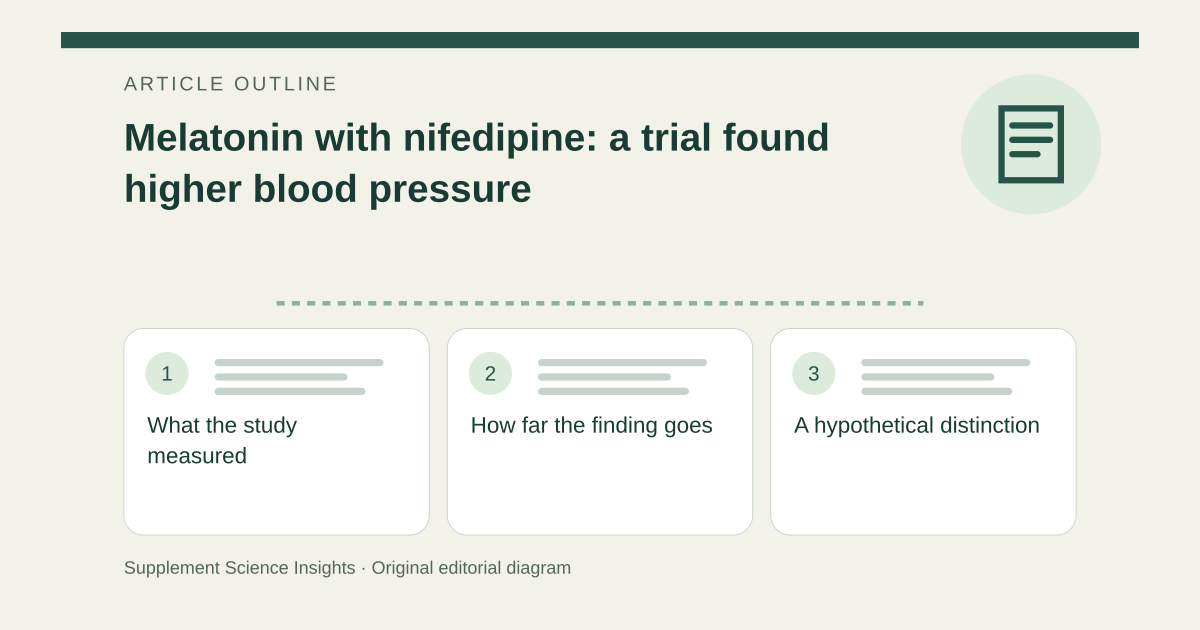
What the study measured
Forty-seven adults whose hypertension was controlled with nifedipine received melatonin or placebo in a double-blind crossover study. Each treatment period lasted four weeks, followed by ambulatory blood-pressure monitoring. [1]
Average systolic pressure was 6.5 mmHg higher and diastolic pressure 4.9 mmHg higher with melatonin. Heart rate also increased. The researchers proposed interference with nifedipine’s effect, but their mechanistic explanation was a hypothesis. [1]
How far the finding goes
This was a particular medicine, population and schedule. It neither proves that melatonin always raises pressure nor supports using it as a general blood-pressure treatment. Funding and conflicts were not established from the retrieved abstract. [1]
A person taking blood-pressure medication should not infer compatibility from a general claim that melatonin helps cardiovascular health. The study does not provide a substitute antihypertensive regimen or a reason to change prescribed treatment without clinical review. [1]
A hypothetical distinction
Imagine a substance lowers one laboratory marker in isolation but changes a medicine’s effect when combined with it. Evidence about the substance alone would not settle the combination’s result.
| Detail | Interpretation |
|---|---|
| 47 participants | Nifedipine-treated hypertension |
| Four weeks per condition | Limited duration |
| Blood pressure | Higher with melatonin |
Sources for this article
- Cardiovascular effects of melatonin in hypertensive patients well controlled by nifedipine: a 24-hour study - PubMed
Source consulted: 2026-09-19. This is a reference resource, not a claim that we conducted the studies or tested a product.