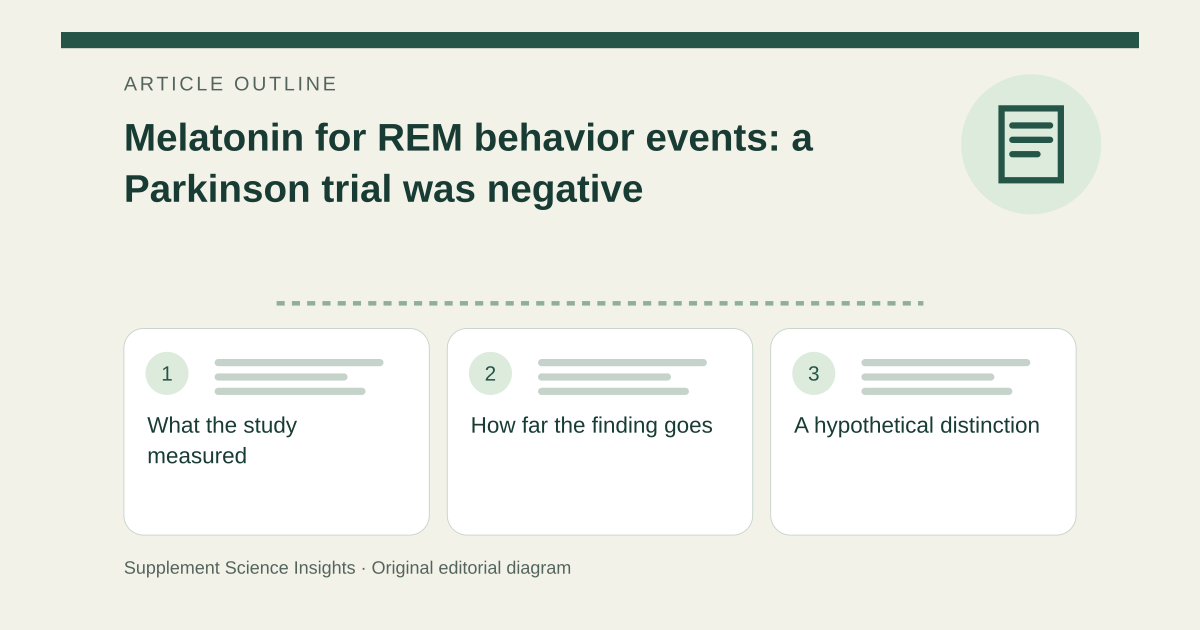
What the study measured
Thirty people with Parkinson disease and REM sleep behavior disorder received prolonged-release melatonin or placebo. The double-blind treatment period lasted eight weeks, with weekly diaries recording behavior incidents. [1]
The primary comparison found about 3.4 events per week with melatonin and 3.6 with placebo, without a significant difference. Mild headache, fatigue and morning sleepiness were reported in both groups. [1]
How far the finding goes
The trial tested one formulation in one disease population. It does not settle every formulation or every cause of REM sleep behavior disorder. Funding and conflicts were not established from the abstract. [1]
Behavioral incidents during REM sleep are not the same endpoint as minutes spent in REM sleep. This study cannot answer whether melatonin increases normal REM duration, and its negative result should not be repackaged as evidence of improved sleep architecture. [1]
A hypothetical distinction
Imagine a diary counts episodes while a sleep recording measures stage duration. A change in one would not automatically establish a change in the other.
| Detail | Interpretation |
|---|---|
| 30 participants | Parkinson disease population |
| Eight weeks | Treatment period |
| Behavior events | No significant reduction |
Sources for this article
- Melatonin for rapid eye movement sleep behavior disorder in Parkinson's disease: A randomised controlled trial - PubMed
Source consulted: 2026-09-19. This is a reference resource, not a claim that we conducted the studies or tested a product.