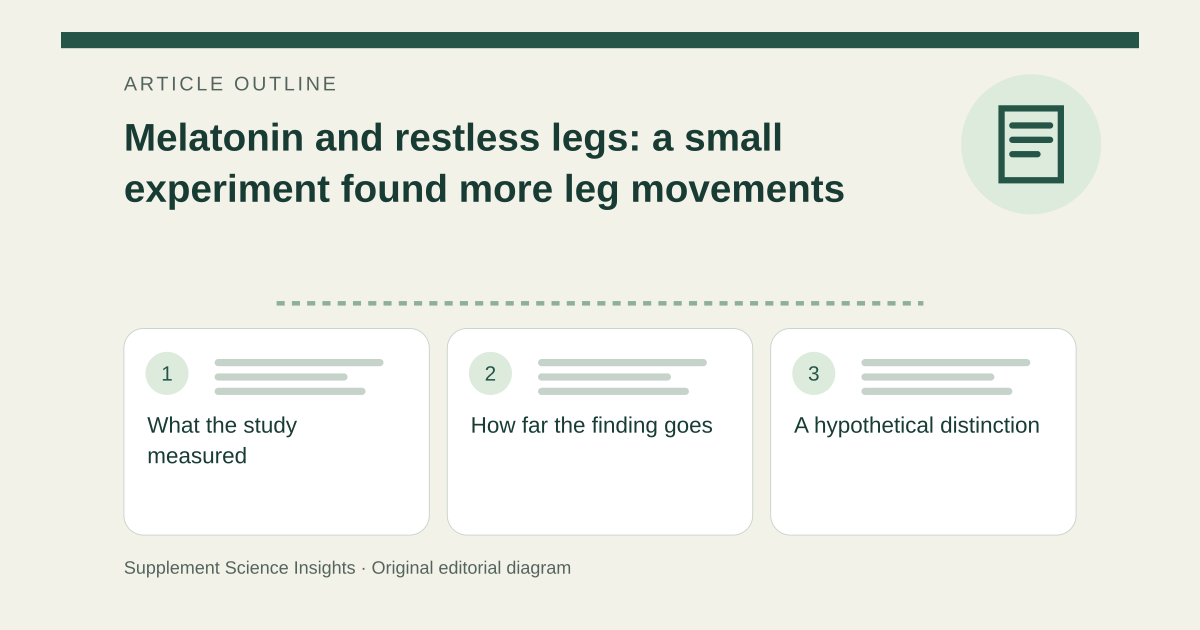
What the study measured
Eight people with restless legs syndrome were assessed at baseline, after melatonin and during bright-light exposure. The suggested immobilization test measured both movement and sensory symptoms. [1]
Leg-movement frequency increased with melatonin compared with baseline and the light condition. Light exposure modestly improved reported discomfort but did not reduce movements compared with baseline. [1]
How far the finding goes
This small physiological experiment cannot establish the long-term effect in all people with restless legs. It also cannot turn a light-exposure observation into a proven clinical light-treatment protocol. Funding and conflicts were not established from the abstract. [1]
The study is relevant because a sleep-related supplement cannot be assumed to improve every sleep-associated condition. Its movement result provides a reason to discuss symptom changes in context, rather than treating greater sleepiness as evidence that restless legs itself has improved. [1]
A hypothetical distinction
Imagine a person feels less discomfort while a movement counter records no change. Those findings can coexist because the instruments measured different aspects of the condition.
| Detail | Interpretation |
|---|---|
| Eight participants | Very small experiment |
| Melatonin condition | More measured movements |
| Light condition | Sensory and motor results differed |
Sources for this article
- Effects of melatonin and bright light administration on motor and sensory symptoms of RLS - PubMed
Source consulted: 2026-09-19. This is a reference resource, not a claim that we conducted the studies or tested a product.