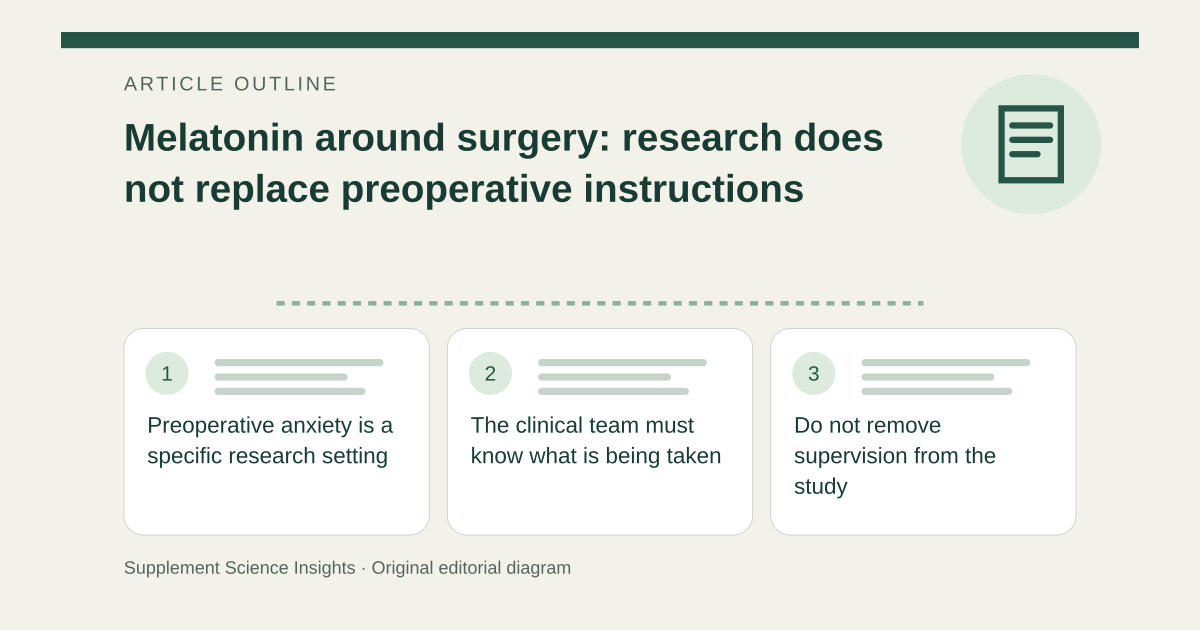
Preoperative anxiety is a specific research setting
NCCIH summarizes a 2015 review of twelve studies involving 774 people that examined melatonin for anxiety before surgery, after surgery or both. It reports stronger evidence for reducing anxiety before surgery than after it. [1]
That distinction matters. A finding in a planned clinical protocol is not a general instruction to add melatonin to an individual’s preparation for anesthesia or postoperative medicines. [1]
The clinical team must know what is being taken
NCCIH advises discussing supplement use with health care providers, particularly when medicines are involved. Melatonin can cause sleepiness, and the full medication and supplement list is relevant around a procedure. [1]
Provide the product, declared amount, usual timing and last use to the surgical or anesthesia team. Follow their instructions rather than using an online article to choose a stop date or an extra preoperative dose. [1]
Do not remove supervision from the study
Imagine a trial gives participants a defined preparation under a clinical protocol. A reader using a different product alongside their own medicines is not reproducing all of those conditions.
The missing context includes the procedure, other drugs and monitoring. Similar intent—feeling less anxious—does not make the exposures equivalent.
| Detail | Meaning |
|---|---|
| Before-surgery anxiety | The studied question |
| Supervised protocol | Part of the intervention |
| Self-directed use after surgery | A different situation |
After surgery is not the same evidence question
The review’s postoperative anxiety findings were mixed. A preoperative result should therefore not be relabeled as proof of better postoperative sleep, healing or recovery. [1]
This article uses the NCCIH summary without independently reappraising the trials. It provides no perioperative dosing plan and does not authorize changing prescribed care. [1]
Sources for this article
- NCCIH: Melatonin—What You Need To Know
Source consulted: 2026-09-17. This is a reference resource, not a claim that we conducted the studies or tested a product.