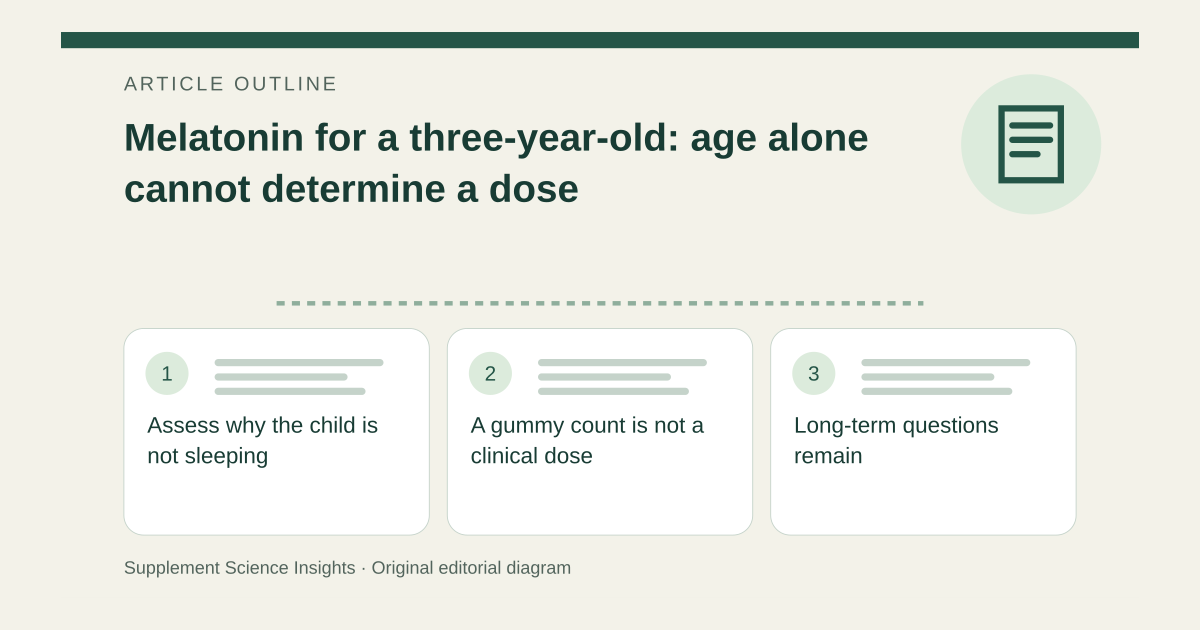
Assess why the child is not sleeping
NCCIH describes behavioral approaches, including bedtime habits and parent education, as initial measures in condition-specific pediatric guidance. The sleep pattern, medical history and other medicines matter. The answer may be a change in routine or assessment of another problem rather than supplementation. [1]
A gummy count is not a clinical dose
Products differ in strength and formulation, and supplement labels may not accurately reflect measured contents. A fractional adult serving or a bottle’s children’s branding does not establish a suitable plan for a three-year-old. If prescribed, use the exact product, amount and timing provided by the treating clinician. [1]
Long-term questions remain
NCCIH identifies uncertainty about pediatric dose, timing, long-term effects and hormonal development. Benefits observed in older children or children with specific conditions cannot simply be applied to all preschoolers. Keep follow-up and the reason for use part of the decision. [1]
Store the product as a medicine, not a treat
Imagine a flavored bottle is kept beside ordinary sweets. Move it out of children’s reach and sight and ensure caregivers know whether any dose has already been given. Suspected accidental ingestion requires poison advice rather than an online routine-dose calculation. [1]
| Bring | Reason |
|---|---|
| Sleep schedule and difficulties | Clarify the actual problem |
| Exact product and other medicines | Assess exposure and interactions |
| Observed benefits and effects | Review ongoing need |
Sources for this article
- Melatonin: What You Need To Know | NCCIH
Source consulted: 2026-09-21. This is a reference resource, not a claim that we conducted the studies or tested a product.