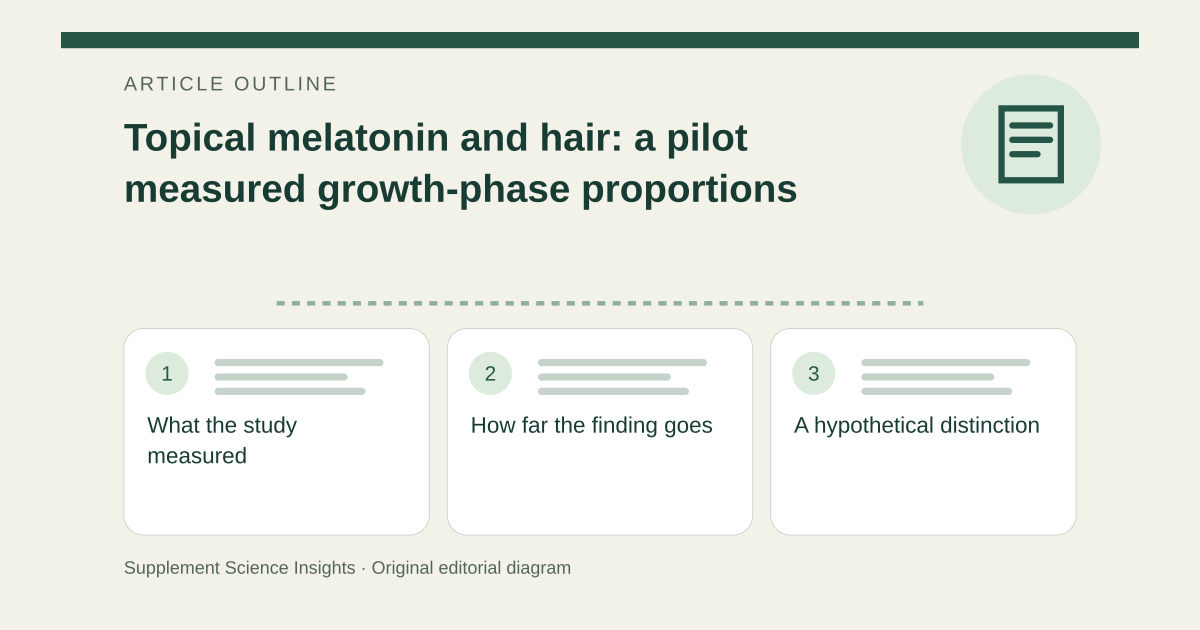
What the study measured
Forty women with diffuse or androgenetic hair loss used a melatonin solution or placebo on the scalp for six months. Investigators assessed the proportion of hairs in growth and resting phases. [1]
Significant differences appeared in selected scalp regions and diagnostic groups, while other region-group comparisons were not significant. Blood melatonin increased but did not exceed the physiological night peak reported by the authors. [1]
How far the finding goes
The small subgroups and mixed regional findings limit generalization. The experiment used a topical preparation, not an oral sleep supplement, and a growth-phase proportion is not a guarantee of noticeable regrowth. Funding and conflicts were not established from the abstract. [1]
This is an early formulation-specific signal. It cannot identify the cause of someone’s hair loss, establish a universal regimen or show that swallowing melatonin recreates scalp exposure from the tested solution. [1]
A hypothetical distinction
Imagine the fraction of sampled hairs in one phase increases in a small scalp area. That observation still leaves separate questions about total density, visible appearance and persistence of any change.
| Detail | Interpretation |
|---|---|
| Topical solution | Route matters |
| 40 women | Pilot population |
| Regional phase counts | Not universal regrowth |
Sources for this article
- Melatonin increases anagen hair rate in women with androgenetic alopecia or diffuse alopecia: results of a pilot randomized controlled trial - PubMed
Source consulted: 2026-09-19. This is a reference resource, not a claim that we conducted the studies or tested a product.