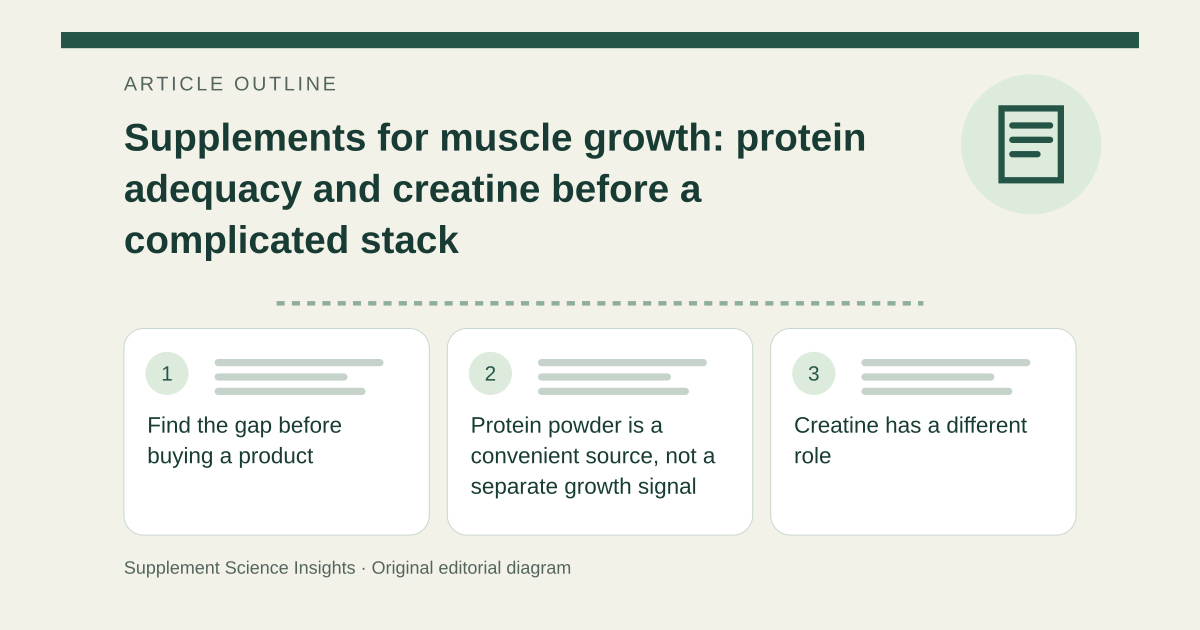
Find the gap before buying a product
NIH ODS emphasizes adequate energy, fluids and nutrients for athletic performance. It summarizes an athlete protein range of 1.2–2.0 g/kg daily, with needs varying by training and context. The amount includes food; it is not a requirement to add that much powder. [1]
Protein powder is a convenient source, not a separate growth signal
Dietary protein supplies essential amino acids for muscle maintenance and repair. A powder is useful when ordinary meals do not meet needs or convenience matters. Compare protein per serving, tolerance and the full diet instead of assuming a special bodybuilding label produces more muscle. [1][2]
Creatine has a different role
ODS describes strong research support for creatine in repeated brief, high-intensity efforts and training-related strength or power outcomes. Creatine monohydrate is the most studied form. Early scale weight can include water retention; that is not the same measurement as new muscle tissue. [1]
A larger stack has a larger evidence gap
Evidence for one ingredient does not validate every multi-ingredient formula. BCAAs, hormone-style boosters and other extras should not be treated as automatically necessary when protein intake is adequate. Product testing can address aspects of quality, but does not prove that the stack increases muscle growth. [1][3]
Use a food record and a training outcome
Imagine a 70-kg athlete compares daily intake with the ODS range: 84–140 g of total protein is the arithmetic reference, not a personal prescription. If meals already cover the agreed target, another shake may add cost and calories without filling a gap. Track strength, training consistency and body-composition goals rather than chasing the fastest claim. [1][2]
| Goal or calculation | Interpretation |
|---|---|
| Protein gap | Food or powder can supply protein |
| Repeated high-intensity training | Creatine may be relevant |
| 70 kg × 1.2–2.0 g/kg | 84–140 g total daily protein reference |
Sources for this article
- Dietary Supplements for Exercise and Athletic Performance - Health Professional Fact Sheet
Source consulted: 2026-09-20. This is a reference resource, not a claim that we conducted the studies or tested a product. - How to Understand and Use the Nutrition Facts Label | FDA
Source consulted: 2026-09-20. This is a reference resource, not a claim that we conducted the studies or tested a product. - Dietary Supplements: What You Need to Know
Source consulted: 2026-09-20. This is a reference resource, not a claim that we conducted the studies or tested a product.