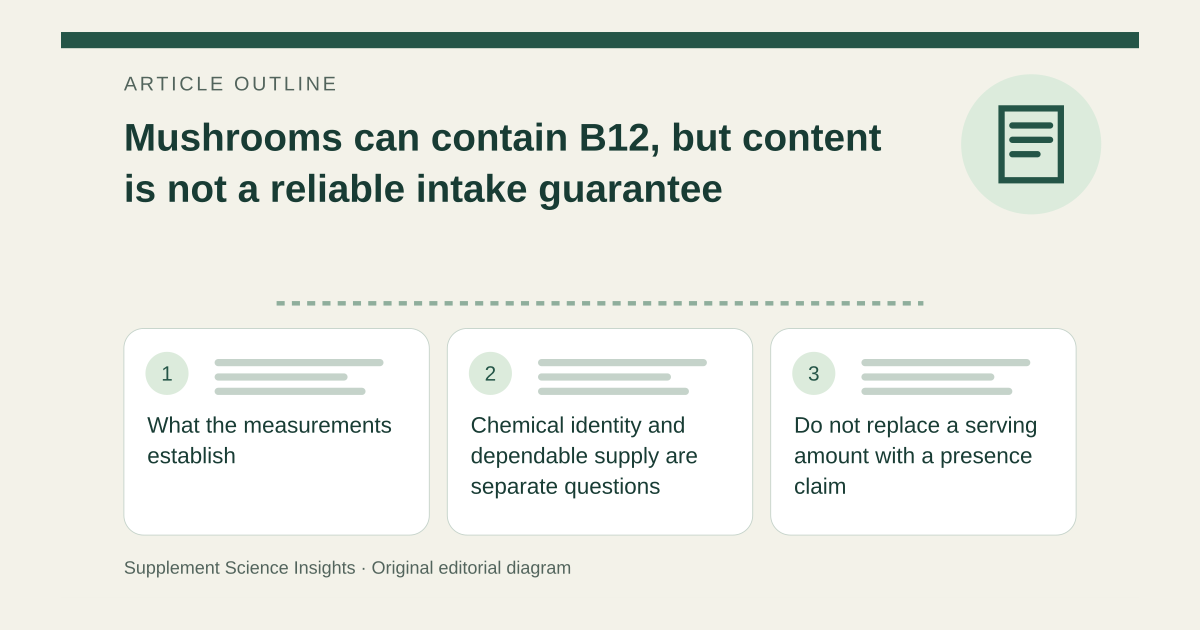
What the measurements establish
Researchers used chromatography and mass spectrometry to examine freshly harvested white button mushrooms from five farms. They identified B12 matching the active standard rather than an inactive pseudovitamin form. [1]
Amounts varied by farm, and outer peel contained more than some other parts. The authors suggested a bacterial origin. Their measurements support presence in the tested samples, not a fixed amount in all mushrooms. [1]
Chemical identity and dependable supply are separate questions
The study did not measure human absorption or test a mushroom-only strategy for preventing deficiency. An identified active compound does not settle the amount delivered by the portions a person actually eats. [2][1]
NIH ODS identifies fortified foods and supplements as B12 options for people avoiding animal foods. Check declared amounts and the full dietary pattern instead of treating every unfortified mushroom serving as a dependable replacement. [2][1]
Do not replace a serving amount with a presence claim
Imagine a food contains detectable B12 but has no reliable amount available for the portion being eaten. Detectable does not establish that the serving closes a particular daily intake gap.
| Detail | Interpretation |
|---|---|
| Active B12 detected | Analytical finding |
| Farm and tissue variation | Amount is not universal |
| Reliable intake plan | Needs usable serving data |
Sources for this article
- Vitamin B12 is the active corrinoid produced in cultivated white button mushrooms (Agaricus bisporus) - PubMed
Source consulted: 2026-09-19. This is a reference resource, not a claim that we conducted the studies or tested a product. - Vitamin B12 - Health Professional Fact Sheet
Source consulted: 2026-09-19. This is a reference resource, not a claim that we conducted the studies or tested a product.