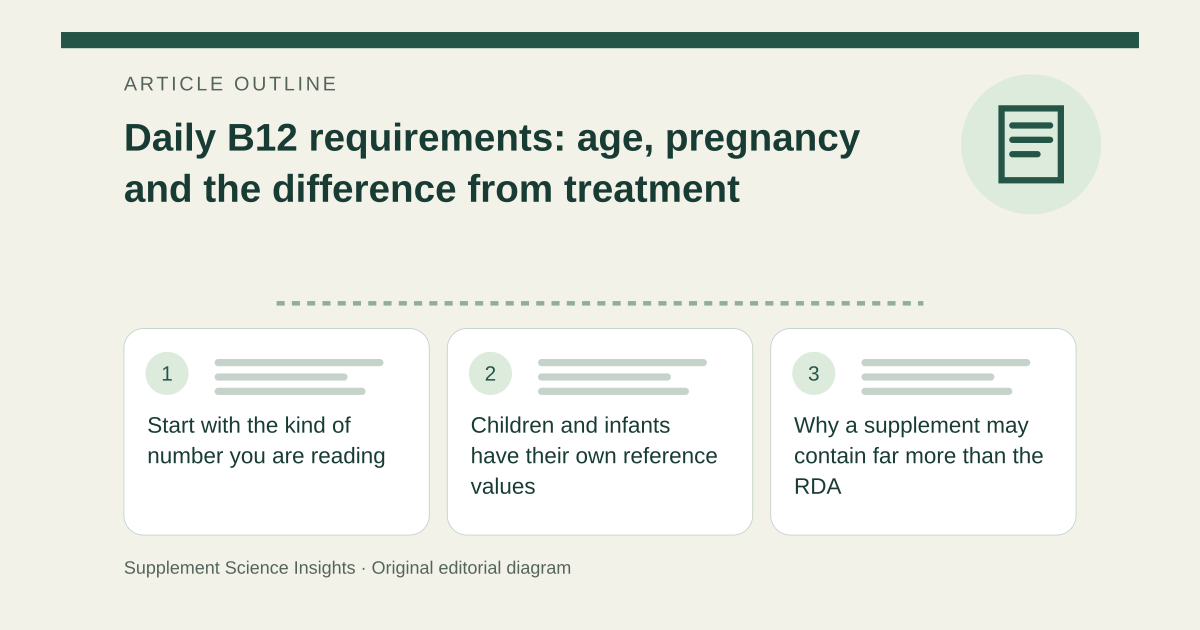
Start with the kind of number you are reading
A daily requirement estimates the intake needed to support normal nutrition. It is different from the amount in a particular tablet, the amount absorbed or a dose used to treat deficiency. Confusing those quantities can make a large supplement label look either essential or automatically excessive without enough context. [1]
NIH ODS reports U.S. Recommended Dietary Allowances for B12 of 2.4 micrograms daily from age 14 onward outside pregnancy and lactation. Pregnancy increases the RDA to 2.6 micrograms and lactation to 2.8 micrograms. These are total-intake values, not additional amounts to add on top of a complete diet. [1]
Children and infants have their own reference values
The B12 RDA is 0.9 micrograms at ages 1–3, 1.2 at ages 4–8 and 1.8 at ages 9–13. For infants, the reference is an Adequate Intake rather than an RDA: 0.4 micrograms from birth through 6 months and 0.5 from 7–12 months. [1]
An Adequate Intake is used when evidence is insufficient to establish an RDA. Neither an infant AI nor a child RDA is an instruction for choosing a drop concentration or measuring a medicine. Feeding method, health and any supplementation decision require age-appropriate advice. [1]
Why a supplement may contain far more than the RDA
B12 absorption is not a fixed fraction at all doses. ODS describes lower fractional absorption at larger supplemental amounts, and clinician-directed replacement may use amounts much greater than nutritional requirements. That is one reason comparing a treatment dose directly with the RDA can be misleading. [1]
The reverse inference is also wrong: the availability of high-dose products does not prove that a person with adequate intake benefits from them. The U.S. Food and Nutrition Board has not set a tolerable upper intake level for B12 because of its low toxicity potential, but that does not create a target to maximize. [1]
A total requirement is not an extra tablet requirement
In a hypothetical adult food record, three entries supply 0.8, 0.6 and 1.0 micrograms of B12. Together they supply 2.4 micrograms. Adding another 2.4 merely because the reference says “daily requirement” would misunderstand what the reference represents.
This invented sum does not prove long-term dietary adequacy or normal absorption. It shows why a total-intake reference should be compared with the whole intake record, rather than automatically assigned as an extra supplement amount.
| Entry | Micrograms |
|---|---|
| Food A | 0.8 |
| Food B | 0.6 |
| Food C | 1.0 |
| Total | 2.4 |
Use a treatment plan for a diagnosed deficiency
Someone with a diagnosed deficiency, gastrointestinal surgery or impaired absorption may need a plan that cannot be inferred from the RDA table. The cause and severity of deficiency, symptoms and response to replacement matter. Do not lower a prescribed dose simply because it exceeds a nutrition reference value. [1]
These figures come from the U.S. reference values summarized by ODS. They are not a personalized prescription or a claim that every country uses identical guidance. No product is chosen because the nutritional reference question does not establish a treatment need. [1]
Sources for this article
- NIH ODS — Vitamin B12: Health Professional Fact Sheet
Source consulted: 2026-09-17. This is a reference resource, not a claim that we conducted the studies or tested a product.