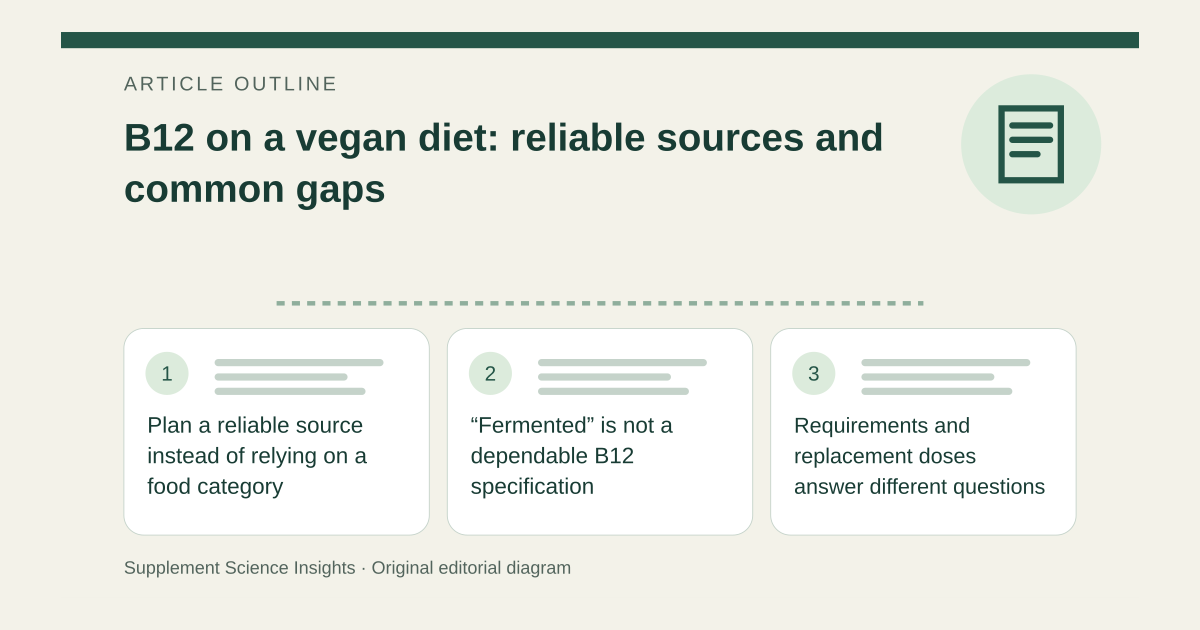
Plan a reliable source instead of relying on a food category
A vegan diet needs a dependable source of vitamin B12. NIH ODS identifies fortified foods and B12 supplements as ways to reduce the deficiency risk associated with excluding animal foods. A varied plant-based diet can still lack enough B12 when it contains no reliable fortified source or supplement. [1]
Fortified breakfast cereals and fortified nutritional yeast are examples, but fortification is a product characteristic. One brand’s B12 declaration cannot be transferred to every cereal, yeast or plant drink. Check the actual label and the portion you use. [1]
“Fermented” is not a dependable B12 specification
The ODS food table lists negligible B12 for many unfortified plant foods and a small amount for tempeh. That is not a basis for treating fermented foods as interchangeable with a measured fortified source. Similarly, the name “nutritional yeast” does not by itself state that B12 was added. [1]
A useful food plan records micrograms per portion and how often the food is actually eaten. If the label does not establish its B12 content, do not fill the gap with an assumed amount. This question concerns reliable nutrient intake, not whether a product is minimally processed. [1]
Requirements and replacement doses answer different questions
For healthy adults, the U.S. B12 Recommended Dietary Allowance is 2.4 micrograms a day, increasing to 2.6 during pregnancy and 2.8 during lactation. These figures describe total dietary requirements under the reference assumptions. They are not a schedule for treating an established deficiency. [1][2]
Absorption problems can coexist with a vegan diet. NICE cautions that diet may not be the only cause of deficiency even when a person excludes animal foods. Persistent symptoms or abnormal tests need assessment rather than an assumption that one more fortified serving will solve the problem. [1][2]
Check the portion actually eaten
Suppose a hypothetical fortified cereal provides 1.2 micrograms of B12 per labeled serving. Half a serving provides 0.6 micrograms; two servings provide 2.4 micrograms. The calculation describes B12 supplied by that invented label, not the amount absorbed or a complete daily menu.
If the cereal is eaten only occasionally, its full serving amount should not appear as a daily entry. A plan based on real portions and frequency is more useful than a list of foods that might contain B12.
| Portion of an invented cereal | B12 supplied |
|---|---|
| Half a labeled serving | 0.6 micrograms |
| One labeled serving | 1.2 micrograms |
| Two labeled servings | 2.4 micrograms |
Pregnancy, breastfeeding and infancy deserve specific planning
ODS highlights the risk of severe deficiency in exclusively breastfed infants when maternal B12 supply is inadequate. A mother’s deficiency can be mild or unrecognized while the infant is affected. Pregnancy and breastfeeding plans therefore need reliable B12 provision and appropriate professional advice. [1]
Do not apply an adult supplement schedule to an infant. This page does not choose a preventive supplement dose or verify the vegan status of capsule ingredients. No product recommendation is made because the question can be answered without assuming a suitable retail preparation. [1]
Sources for this article
- NIH ODS — Vitamin B12: Health Professional Fact Sheet
Source consulted: 2026-09-17. This is a reference resource, not a claim that we conducted the studies or tested a product. - NICE NG239 — Vitamin B12 deficiency in over 16s: recommendations
Source consulted: 2026-09-17. This is a reference resource, not a claim that we conducted the studies or tested a product.