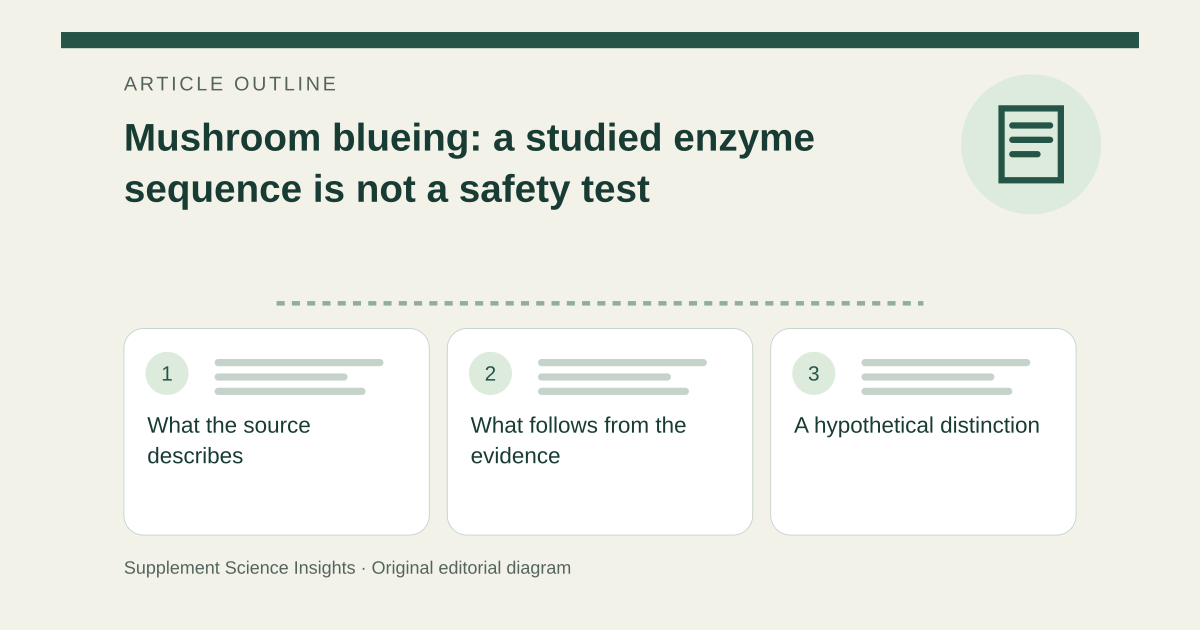
What the source describes
The laboratory study identified two enzymes acting in sequence. One removes a phosphate from psilocybin, and the other initiates oxidation leading to a mixture of linked, colored products. [1][2]
Spectroscopic methods supported formation of multiple oligomeric products rather than one simple blue molecule. The work addressed reaction chemistry, not a calibrated field assay for drug content. [1][2]
What follows from the evidence
Blue bruising is not unique to this setting: Missouri’s pallid-bolete profile also describes possible blue staining. Color alone therefore cannot identify a psychoactive species. The chemistry study reports research support from German funding bodies and does not establish clinical safety or recommend consumption. [1][2]
A hypothetical distinction
Imagine two organisms develop a similar visible color through different chemistry. The shared appearance does not make their composition or risks equivalent.
| Detail | Interpretation |
|---|---|
| Visible color | A chemical observation |
| Species identity | Needs more evidence |
| Potency estimate | Not validated by this study |
Sources for this article
- Injury‐Triggered Blueing Reactions of Psilocybe “Magic” Mushrooms - PMC
Source consulted: 2026-09-19. This is a reference resource, not a claim that we conducted the studies or tested a product. - Pallid Bolete | Missouri Department of Conservation
Source consulted: 2026-09-19. This is a reference resource, not a claim that we conducted the studies or tested a product.