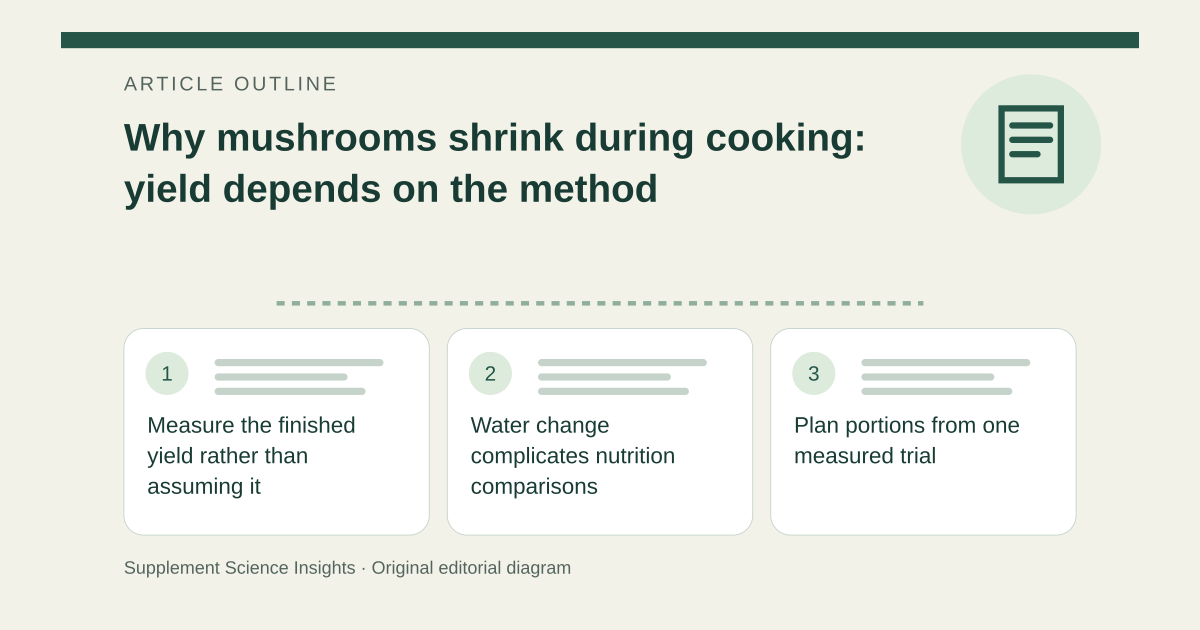
Measure the finished yield rather than assuming it
USU notes that mushrooms shrink during cooking and describes sautéing until the released liquid is gone or the mushrooms brown. The amount remaining depends on the starting mushrooms and the preparation. A long stew and a quick sauté do not necessarily create the same portion size or texture. [1]
Water change complicates nutrition comparisons
If the cooked batch weighs less, nutrients per 100 g can appear more concentrated even without an increase in the batch’s total nutrient amount. Oil and sauce can add weight and nutrients of their own. Compare the actual recipe yield, not just a raw and cooked number from unrelated preparations. [1]
Plan portions from one measured trial
Imagine 400 g of trimmed mushrooms produces 250 g after your usual sauté. The cooked yield is 62.5% of the starting mass, and the measured mass reduction is 37.5%. Use that as a planning estimate for the same recipe, not as a universal mushroom constant. [1]
| Example | Interpretation |
|---|---|
| 400 g before and 250 g after | 62.5% cooked yield |
| 150 g difference | 37.5% mass reduction |
| Added oil or sauce | Changes the calculation |
Sources for this article
- Fruit and Vegetable Guide Series: Mushrooms | USU
Source consulted: 2026-09-20. This is a reference resource, not a claim that we conducted the studies or tested a product.