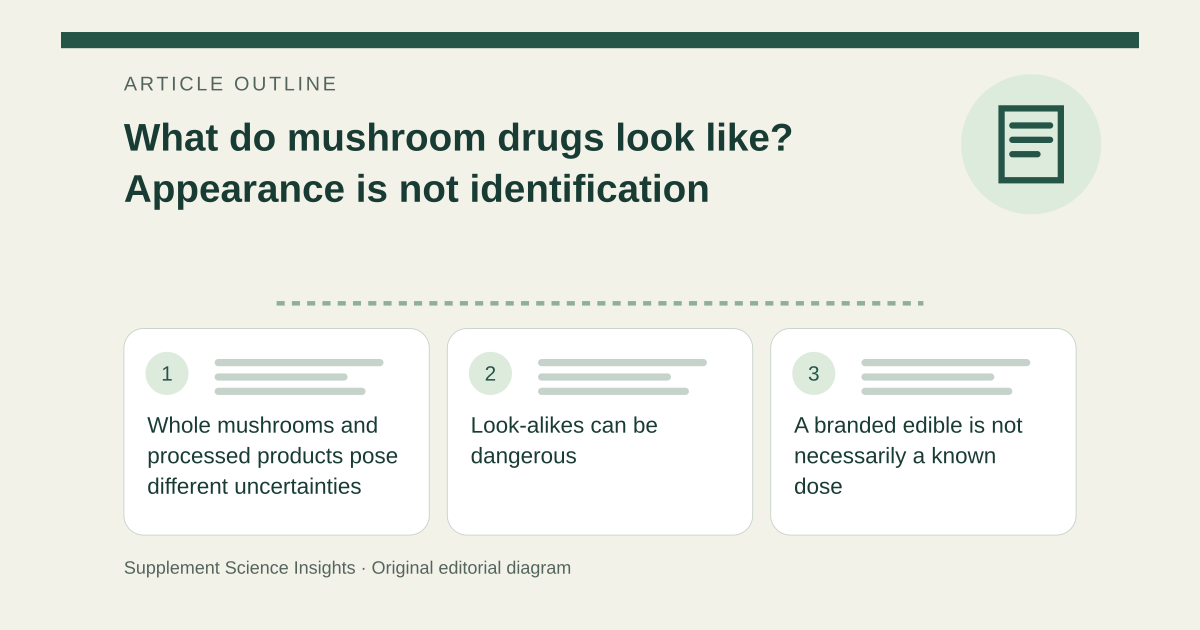
Whole mushrooms and processed products pose different uncertainties
Fresh and dried psilocybin-containing mushrooms can be eaten or incorporated into drinks and foods. Processing may conceal the original material, so color, shape or a familiar package is not a reliable chemical test. [1][2]
Look-alikes can be dangerous
Poisonous mushrooms can resemble psychoactive species. Drying, cooking or soaking does not reliably eliminate their toxins. Do not identify an unknown mushroom for consumption using a few visual traits or an online photo. [3]
A branded edible is not necessarily a known dose
NIDA warns that illicitly produced or processed drugs can have unexpected ingredients or contaminants. A mushroom graphic, strain name or number of pieces cannot establish the actual exposure. [4]
Treat an accidental ingestion as an exposure question
Imagine a child eats an unlabeled mushroom-shaped gummy. Keep the packaging and contact Poison Control promptly, even if the product resembles ordinary candy. Severe symptoms require emergency services. [3]
| Appearance | Cannot establish |
|---|---|
| Brown dried pieces | Safe species |
| Fine powder | Chemical identity |
| Capsule or gummy | Accurate dose |
| Professional packaging | Clinical safety |
Sources for this article
- Psilocybin for Mental Health and Addiction: What You Need To Know | NCCIH
Source consulted: 2026-09-21. This is a reference resource, not a claim that we conducted the studies or tested a product. - Psilocybin
Source consulted: 2026-09-21. This is a reference resource, not a claim that we conducted the studies or tested a product. - Magic Mushrooms (Psilocybin) Safety | California Poison Control System
Source consulted: 2026-09-21. This is a reference resource, not a claim that we conducted the studies or tested a product. - Psychedelic and Dissociative Drugs | National Institute on Drug Abuse (NIDA)
Source consulted: 2026-09-21. This is a reference resource, not a claim that we conducted the studies or tested a product.