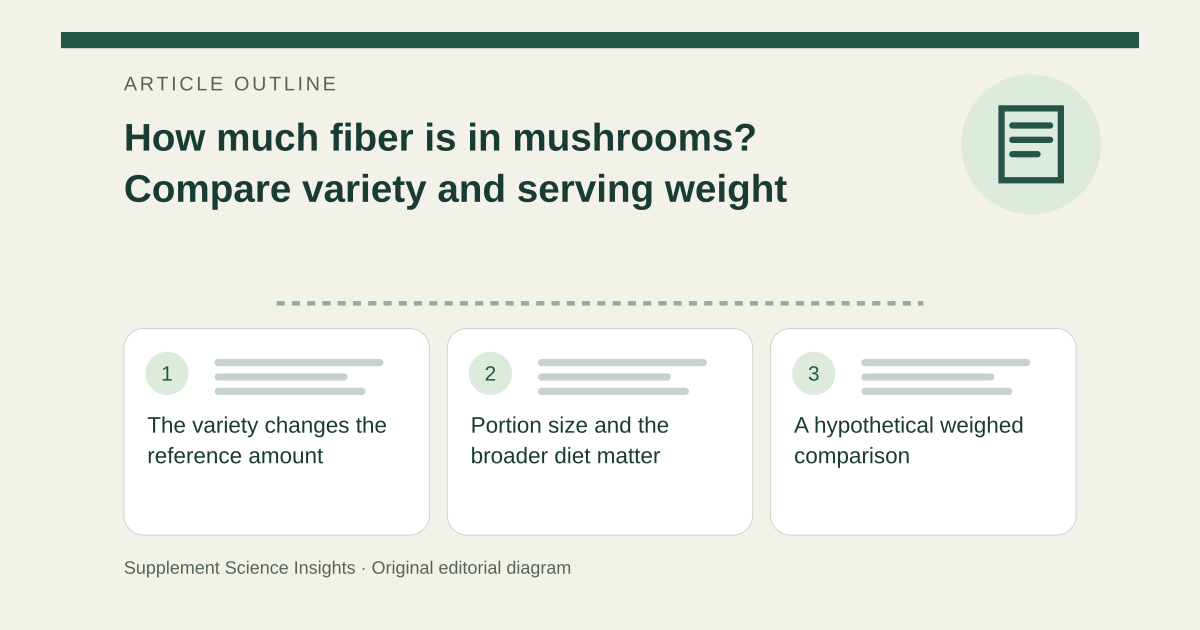
The variety changes the reference amount
Per 100 g raw food, USDA SR Legacy 2018 reports 1.0 g fiber for white mushrooms, 0.6 g for crimini, 2.5 g for shiitake, 2.3 g for oyster mushrooms and 2.7 g for enoki. These are total dietary-fiber values, not measurements of a specific beta-glucan product or its biological activity. [1]
Portion size and the broader diet matter
A 70 g reference cup of raw sliced white mushrooms supplies about 0.7 g fiber. NIDDK explains that adequate dietary fiber and fluids can help with constipation, but that general guidance does not establish a clinical outcome for one mushroom variety. This comparison concerns food composition and does not recommend eating mushrooms raw or identifying wild mushrooms for consumption. [1][2]
A hypothetical weighed comparison
For 80 g portions, white mushrooms provide an estimated 0.8 g fiber and oyster mushrooms 1.8 g. Cooking changes the serving’s water content and weight, so use a cooked-food entry when logging cooked portions. Do not treat one raw cup as automatically equivalent to one cooked cup. [1]
| Mushroom variety | Estimated fiber |
|---|---|
| White | 0.8 g |
| Oyster | 1.8 g |
Sources for this article
- USDA FoodData Central — SR Legacy April 2018 food composition dataset
Source consulted: 2026-09-20. This is a reference resource, not a claim that we conducted the studies or tested a product. - Eating, Diet, & Nutrition for Constipation - NIDDK
Source consulted: 2026-09-20. This is a reference resource, not a claim that we conducted the studies or tested a product.