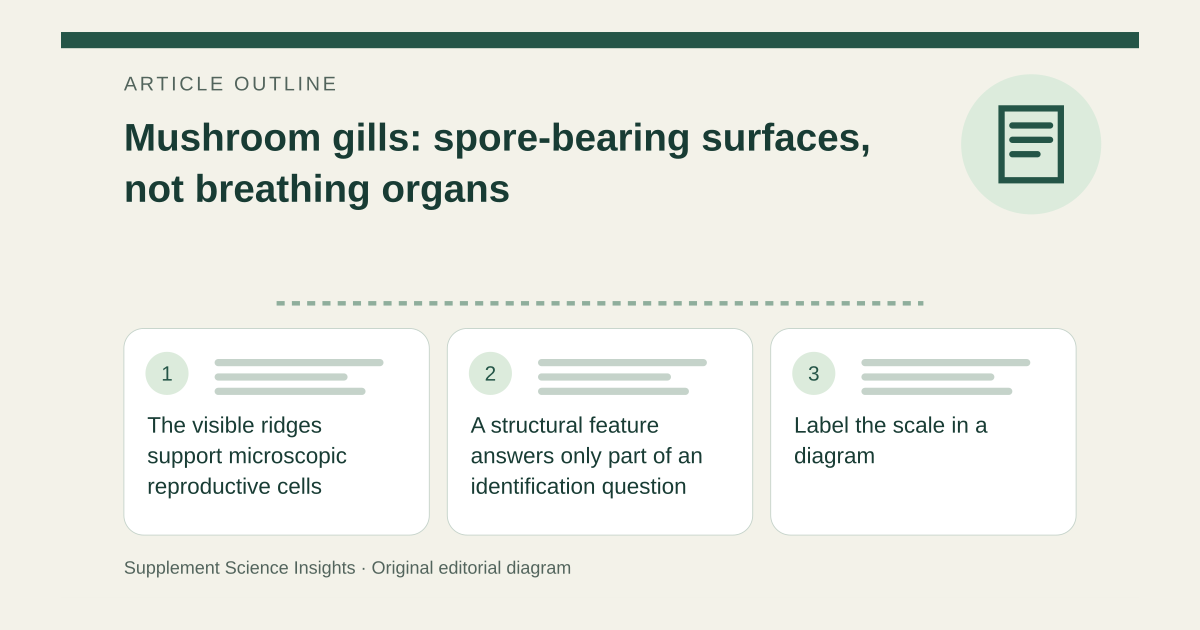
The visible ridges support microscopic reproductive cells
In typical gilled basidiomycete mushrooms, the ridges beneath the cap contain tightly organized fungal filaments. Their surfaces bear basidia, the microscopic cells on which sexual spores develop. [1]
The mushroom itself is a larger fruiting body. A basidium is not another name for the whole mushroom, and a spore is not a miniature cap waiting to expand. [1]
A structural feature answers only part of an identification question
Recognizing a gill explains where spores are produced in this type of mushroom. It does not identify a species, establish edibility or describe every fungal reproductive structure. [1]
For interpreting educational diagrams, keep three scales separate: the fruiting body visible to the eye, the gill surface and the microscopic spore-producing cell. The cited textbook provides structural biology, not a laboratory assessment of a mushroom someone has found. [1]
Label the scale in a diagram
Imagine a drawing points to an entire cap and labels it basidium. The label has confused an organism-scale structure with one of its microscopic reproductive cells; enlarging the relevant surface would clarify the distinction.
| Detail | Interpretation |
|---|---|
| Fruiting body | Visible reproductive structure |
| Gill | Spore-bearing surface |
| Basidium | Microscopic spore-producing cell |
Sources for this article
- 24.2 Classifications of Fungi - Biology 2e | OpenStax
Source consulted: 2026-09-19. This is a reference resource, not a claim that we conducted the studies or tested a product.