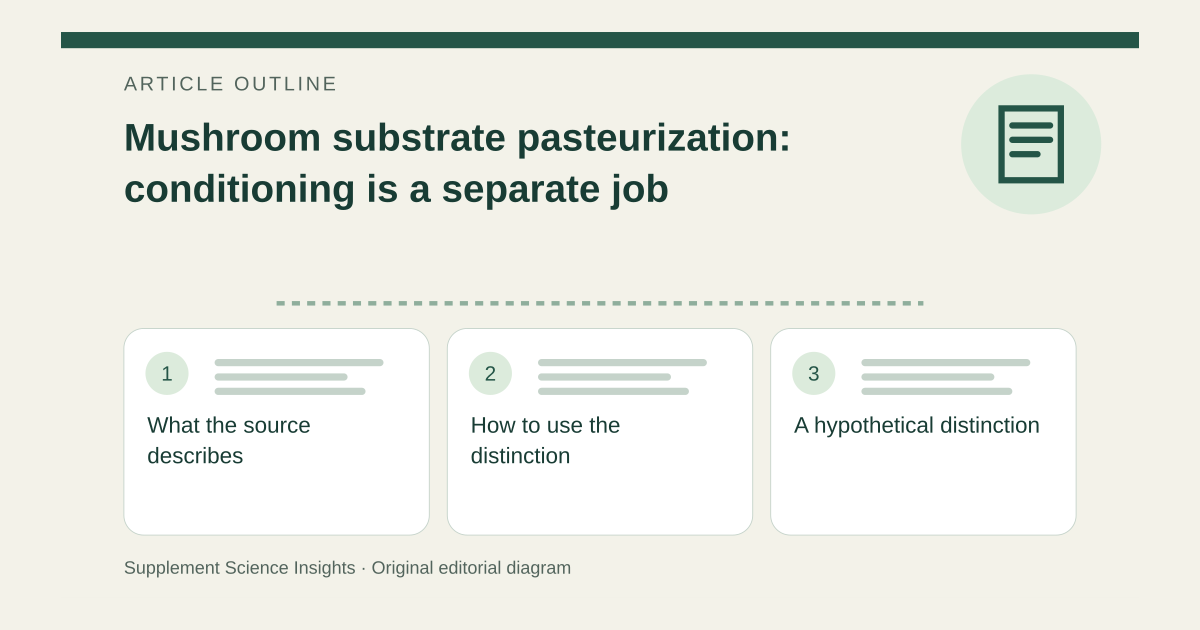
What the source describes
Penn State describes Phase II as both pasteurization and completion of compost conditioning. The first goal reduces pests and competing organisms without eliminating every microbe. [1]
The second goal includes reducing residual ammonia and readily available compounds from earlier composting. Microbial activity converts nitrogen-containing material into forms the mushroom can use; excessive ammonia inhibits spawn growth. [1]
How to use the distinction
A short heat exposure alone does not prove both goals were achieved. Time, temperature, aeration and the actual substrate matter. This account of commercial Agaricus compost should not be substituted for a validated process for every mushroom-growing medium. [1]
A hypothetical distinction
Imagine a substrate reaches a target temperature but still contains inhibitory ammonia. Heating and conditioning have not become the same endpoint.
| Detail | Interpretation |
|---|---|
| Observation | Keep the original context |
| Handling or method | Match the specific material |
| Limit | Do not infer a universal guarantee |
Sources for this article
- Basic Procedures for Agaricus Mushroom Growing
Source consulted: 2026-09-19. This is a reference resource, not a claim that we conducted the studies or tested a product.