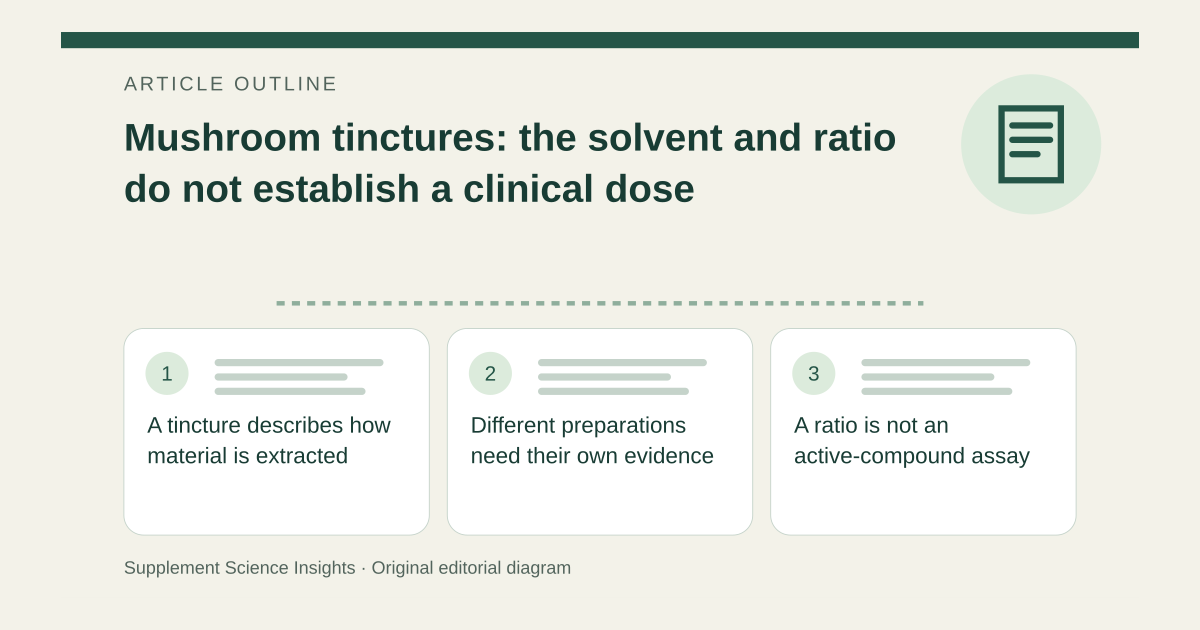
A tincture describes how material is extracted
NIH ODS describes tinctures as preparations made by soaking source material in alcohol and water. Extract ratios relate starting material to finished extract according to a stated convention. [1]
The ratio is not automatically the amount of a particular active constituent. It must be read with its units and the manufacturer’s definition of the starting and finished materials. [1]
Different preparations need their own evidence
For a practical comparison, record the species, source material, alcohol-containing formulation, declared amount per serving and serving volume from each label. A dropper is not a universal unit of volume or strength. A product’s labeled serving also does not demonstrate an effective clinical dose; ODS emphasizes that preparation and amount affect safety, and that standardization alone does not establish effectiveness. [1]
A liquid tincture and a dry extract may differ in constituents and concentration. Matching the organism’s name alone does not establish that their effects or serving amounts are interchangeable. [1]
This general preparation definition is not a mushroom efficacy review or a home-extraction recipe. Species, material identity, full formulation and evidence for the intended use remain necessary. [1]
A ratio is not an active-compound assay
Imagine a label gives an extraction ratio but no amount for the compound discussed in a study. The ratio alone cannot fill in that missing quantity.
| Detail | Interpretation |
|---|---|
| Tincture | Liquid preparation format |
| Extraction ratio | Defined material relationship |
| Clinical dose | Not supplied by the ratio alone |
Sources for this article
- Botanical Dietary Supplements Background Information - Consumer
Source consulted: 2026-09-18. This is a reference resource, not a claim that we conducted the studies or tested a product.