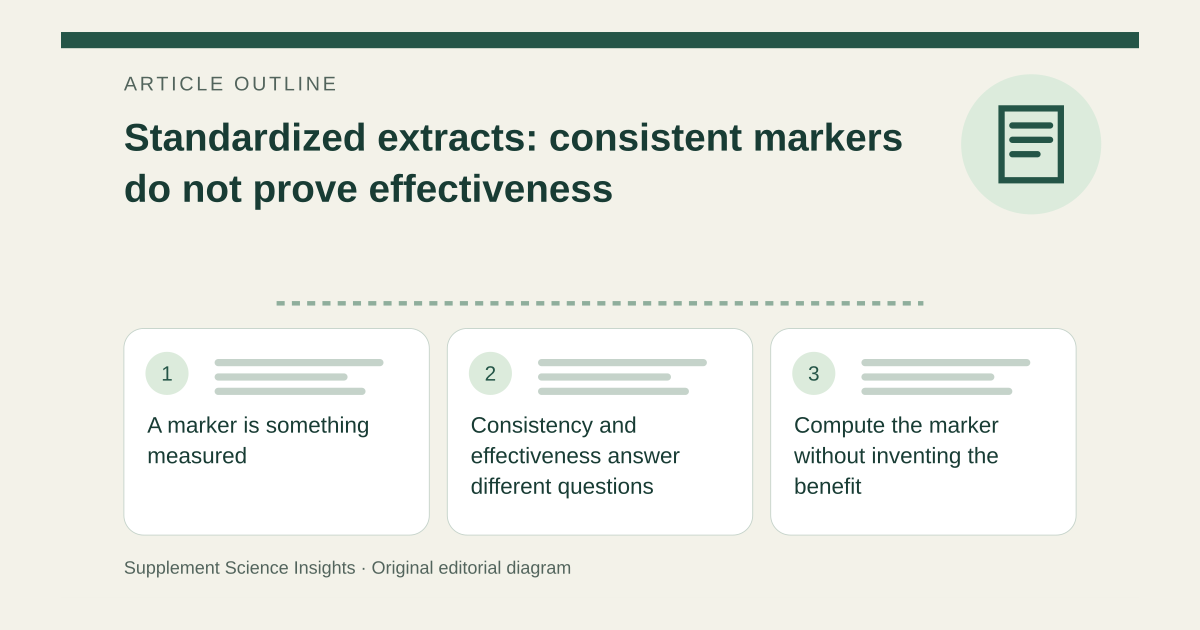
A marker is something measured
NIH ODS explains that manufacturers may identify and adjust specific chemicals to make batches more similar. The selected marker is not necessarily the constituent responsible for an observed effect. [1]
Where several compounds contribute, controlling one value does not characterize the entire preparation. The percentage needs its named marker and ingredient amount to be interpretable. [1]
Consistency and effectiveness answer different questions
A standardized product can be consistently made while still lacking evidence for a particular use. Clinical interpretation requires the studied preparation, population, amount and outcome. [1]
The word also does not independently verify contaminants, identity or every manufacturing specification. Treat it as a claim with a defined analytical scope rather than a universal quality seal. [1]
Compute the marker without inventing the benefit
Imagine 200 mg of an extract is standardized to 5% of a named marker. That represents 10 mg of the marker, not proof that 10 mg produces the advertised effect.
| Detail | Interpretation |
|---|---|
| Standardized marker | Measured consistency |
| Other constituents | Not fully described |
| Clinical effect | Separate evidence |
Sources for this article
- Botanical Dietary Supplements Background Information - Consumer
Source consulted: 2026-09-18. This is a reference resource, not a claim that we conducted the studies or tested a product.