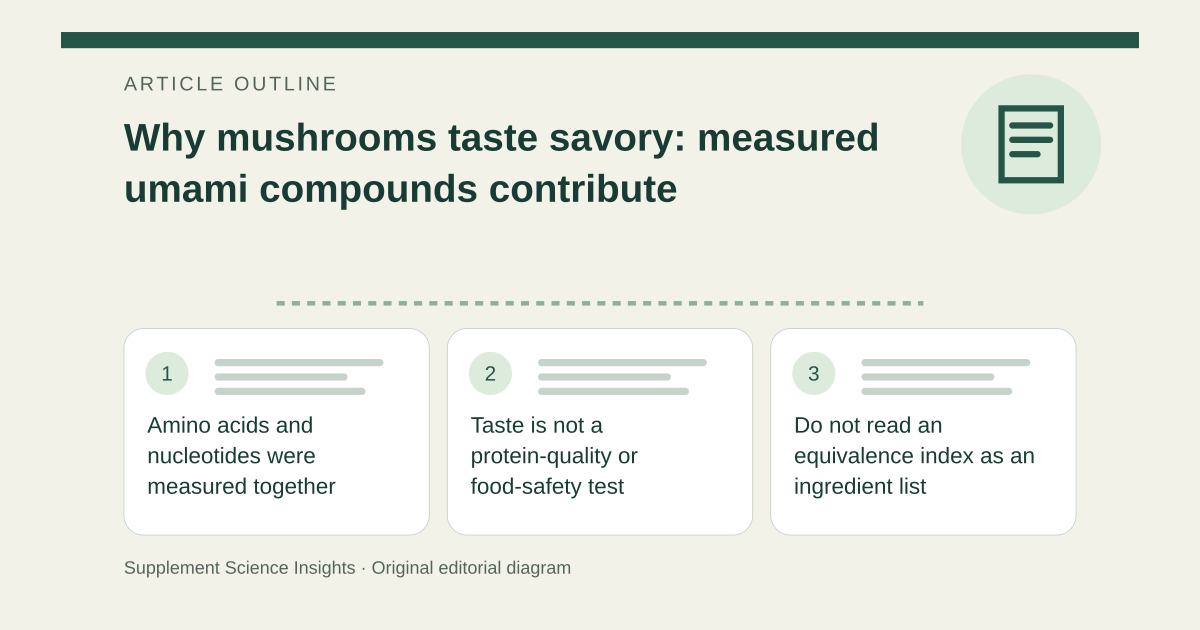
Amino acids and nucleotides were measured together
Researchers analyzed 17 mushroom types available commercially in Korea for free glutamic and aspartic acids and several nucleotides. They compared the chemistry with human sensory ratings and an electronic taste-sensing system. [1]
Many samples produced strong umami findings, but the highest-rated sample depended on the measurement method. Oyster mushroom ranked highest in the human sensory evaluation, while another type ranked highest on the electronic system. [1]
Taste is not a protein-quality or food-safety test
The experiment studied extracts and taste-related chemistry. It did not establish equivalent protein content to meat, explain every aspect of cooked texture or validate wild-mushroom edibility. [1]
Funding and conflicts were not established from the abstract. A calculated equivalent umami concentration is a taste index, not the amount of monosodium glutamate someone physically added. Keep the analytical metric separate from ingredient declarations and the nutritional contribution of a serving. [1]
Do not read an equivalence index as an ingredient list
Imagine a laboratory reports MSG-equivalent taste intensity. That wording does not show that MSG was added to the food; it expresses a comparison on a sensory scale.
| Detail | Interpretation |
|---|---|
| Free amino acids and nucleotides | Measured taste compounds |
| Sensory ranking | Depends on method |
| Meat-equivalent nutrition | Not established |
Sources for this article
- Evaluation of umami taste in mushroom extracts by chemical analysis, sensory evaluation, and an electronic tongue system - PubMed
Source consulted: 2026-09-19. This is a reference resource, not a claim that we conducted the studies or tested a product.