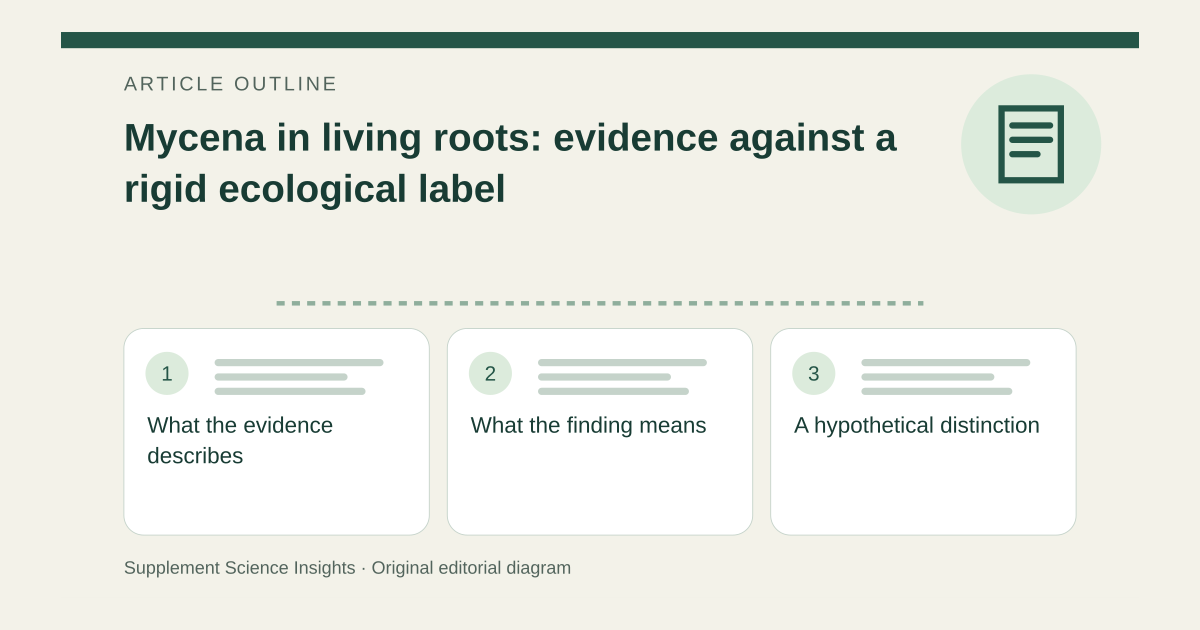
What the evidence describes
Researchers surveyed root-sequence datasets from ten plant species and examined stable-isotope patterns in Mycena fruiting bodies from five locations. Mycena appeared in roots of nine of the ten plant hosts. [1]
The isotope patterns were compatible with more than one nutritional lifestyle. Together, the findings supported the authors’ interpretation that some Mycena can enter living roots opportunistically. [1]
What the finding means
Occurrence and isotope associations do not prove every interaction benefits or harms the host. They also do not establish that this behavior evolved recently, that all species behave identically, or that a mushroom is edible. Funding and conflicts were not established from the repository abstract. [1]
A hypothetical distinction
Imagine a genus usually classified as a decomposer is detected inside healthy roots. That observation challenges a rigid category without defining every interaction.
| Detail | Interpretation |
|---|---|
| Finding | Preserve the measured or observed outcome |
| Context | Species, preparation or setting matters |
| Limit | No universal safety or benefit guarantee |
Sources for this article
- Mycena species can be opportunist-generalist plant root invaders - NERC Open Research Archive
Source consulted: 2026-09-19. This is a reference resource, not a claim that we conducted the studies or tested a product.