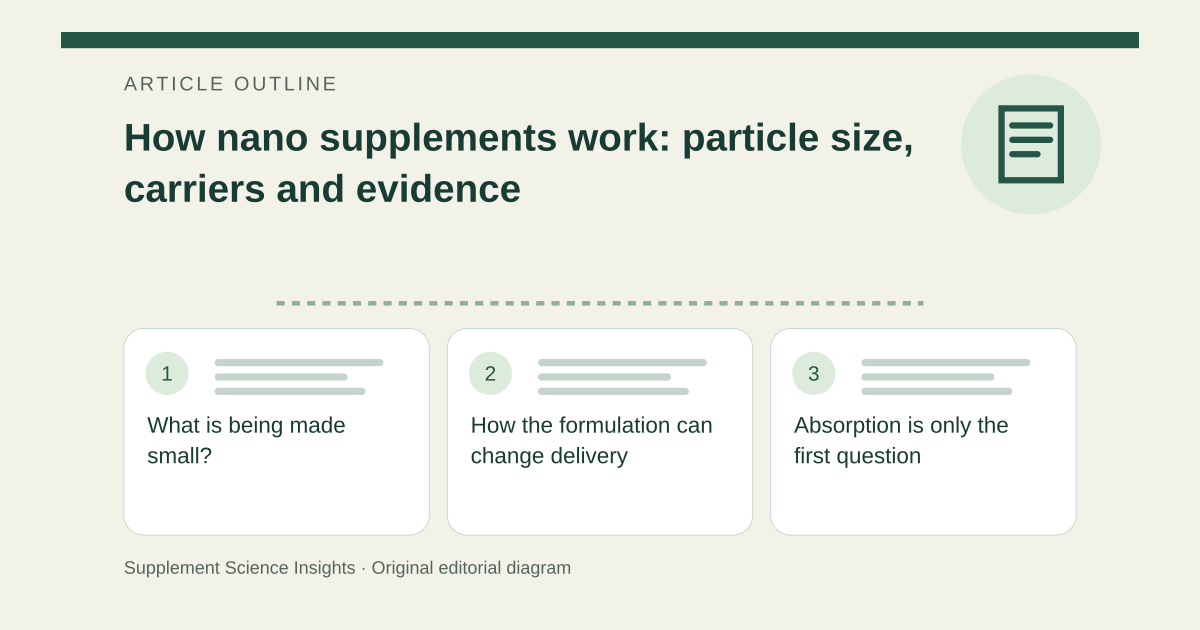
What is being made small?
A nano supplement may contain very small particles of an ingredient, or place an ingredient inside or alongside a small delivery carrier. These are different designs. Before asking whether it works better, identify what was measured: the active ingredient, a droplet, a lipid carrier or an aggregate of several particles. [1]
FDA describes nanoscale dimensions as approximately 1 to 100 nanometers in its overarching guidance, while also considering certain dimension-dependent properties outside that range. A marketing word is not a measurement report. The size distribution, composition and behavior of the finished formulation matter more than an isolated “nano” label. [1]
How the formulation can change delivery
Breaking a material into smaller particles can increase its surface area relative to its mass. A carrier changes a different set of features, such as the surface that contacts digestive fluid. Liposomes, for example, are small lipid-based sacs that can carry substances. A liposome label does not by itself establish a particular particle size, survival through digestion or delivery to a target tissue. [2][3]
FDA emphasizes that surface composition, charge and other physical properties can affect biological interactions. Consequently, two formulations containing the same mass of an ingredient need not behave identically. Size is one variable among several, rather than a universal explanation for all changes in absorption. [2][3]
Absorption is only the first question
First ask whether a human study measured greater exposure to the ingredient from the specific formulation. Then ask whether a relevant health outcome improved. A larger blood concentration does not answer the second question automatically. Finally, ask whether the changed exposure and formulation were assessed for safety over a relevant duration. [1][2]
Comparisons also need comparable doses and a clearly identified reference product. A carrier containing several other ingredients makes it harder to attribute an outcome to particle size alone. Evidence from a cell experiment, an injected medicine or a skin product cannot simply be transferred to an oral supplement. [1][2]
Interpreting a hypothetical absorption claim
Suppose a seller reports twice the blood exposure after a nano formulation, compared with its conventional formulation, at the same administered amount. That could support a formulation-specific pharmacokinetic claim if the human study was well designed. It would not mean twice the symptom relief, nor would it establish that half the dose has the same clinical effect. Those require their own comparisons. Ask for the tested formulation, measured outcome and limitations before treating a delivery claim as a health claim. [1]
| Reported result | Interpretation |
|---|---|
| Twofold blood exposure | A measured difference in exposure under the study conditions |
| No symptom outcome measured | No corresponding symptom-benefit estimate |
| Different retail formulation | The study cannot automatically establish equivalence |
Sources for this article
- Considering Whether an FDA-Regulated Product Involves the Application of Nanotechnology | FDA
Source consulted: 2026-09-20. This is a reference resource, not a claim that we conducted the studies or tested a product. - Nanotechnology Task Force Report 2007 | FDA
Source consulted: 2026-09-20. This is a reference resource, not a claim that we conducted the studies or tested a product. - Definition of liposome - NCI Dictionary of Cancer Terms - NCI
Source consulted: 2026-09-20. This is a reference resource, not a claim that we conducted the studies or tested a product.