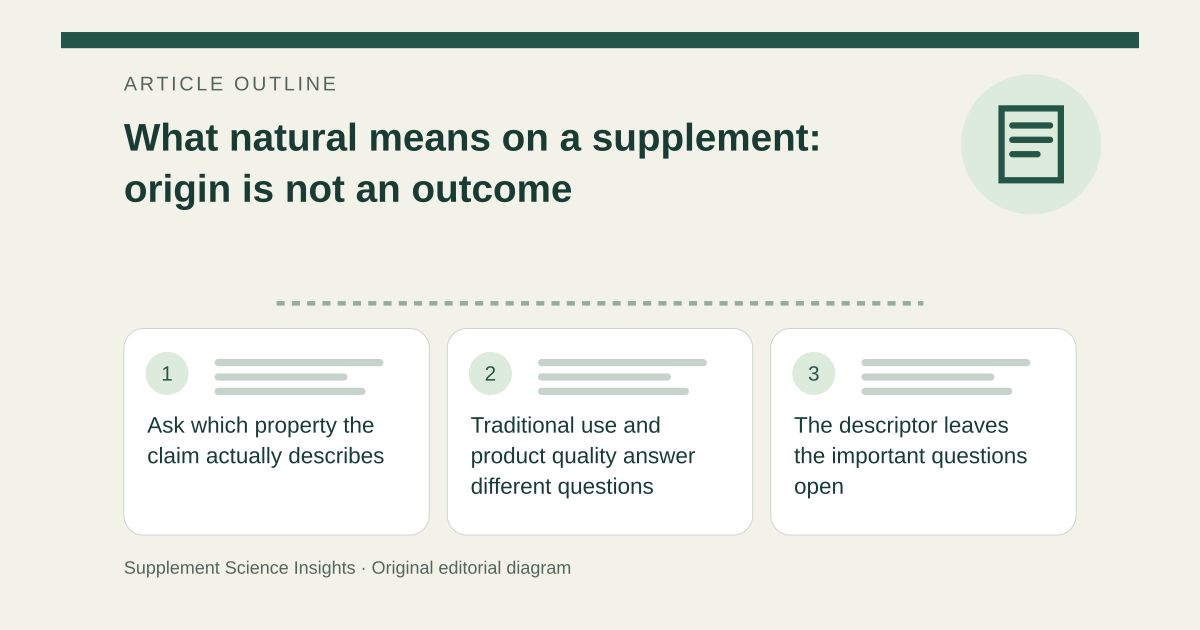
Ask which property the claim actually describes
A botanical ingredient may originate from a plant, but extraction, concentration and formulation affect what a person takes. ODS explains that safety depends on chemical makeup, preparation, action in the body and amount. [1]
A natural-origin statement therefore cannot answer whether a particular dose is appropriate, whether a mixture interacts with medicines or whether the advertised benefit has been demonstrated. Those require separate evidence. [1]
Traditional use and product quality answer different questions
Traditional use can explain why an ingredient attracted interest, but it does not replace a controlled comparison for a specific clinical claim. Similarly, a quality certification does not prove that a preparation treats a disease or suits every user. [1]
Read the exact ingredient identity and relevant evidence rather than using natural as a shortcut for the conclusion. ODS gives examples of botanicals capable of harming the liver, illustrating why plant origin alone cannot be a safety guarantee. [1]
The descriptor leaves the important questions open
Imagine two products both say all natural but contain different extracts and amounts. The phrase does not make their exposures equivalent. Each still needs a composition, evidence and interaction assessment.
| Detail | Implication |
|---|---|
| Origin | One descriptive property |
| Safety | Depends on exposure and context |
| Effectiveness | Needs outcome evidence |
Sources for this article
- NIH ODS: Dietary Supplements — What You Need to Know
Source consulted: 2026-09-17. This is a reference resource, not a claim that we conducted the studies or tested a product.