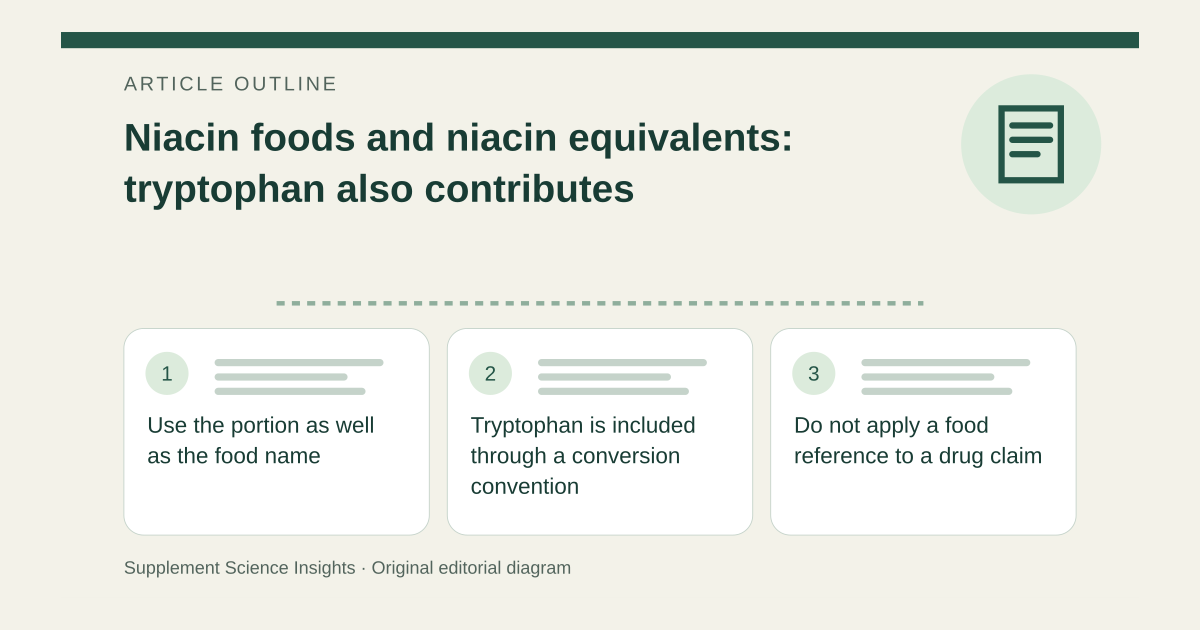
Use the portion as well as the food name
ODS lists about 10.3 mg niacin in three ounces of grilled chicken breast, 8.6 mg in three ounces of cooked sockeye salmon and 4.2 mg in an ounce of dry-roasted peanuts. These are reference food-composition values, not exact measurements of every serving. [1]
Enriched and fortified grains can also contribute. Naturally occurring niacin in some grains is relatively bound and less available, while added niacin is in a more available free form. A whole-food name alone does not determine absorbed exposure. [1]
Tryptophan is included through a conversion convention
The body can use tryptophan to make niacin-related compounds. The reference convention counts 60 mg tryptophan as one milligram of niacin equivalents, or NE. ODS emphasizes that conversion efficiency varies between people. [1]
The adult RDA is 16 mg NE for men and 14 mg NE for women; pregnancy and breastfeeding values are 18 and 17 mg NE respectively. These values describe total nutritional supply, not a recommendation to take isolated tryptophan to reach the number. [1]
Do not apply a food reference to a drug claim
Niacin in ordinary nutrition and high-dose nicotinic acid used in a medical context are different questions. A food’s vitamin contribution does not establish cholesterol-treatment efficacy, and a dietary target is not a therapeutic regimen. [1]
For a food record, preserve whether a value is measured niacin or a calculated equivalent. Mixing those definitions can create misleading comparisons. [1]
Show what the arithmetic represents
Using the convention, 120 mg tryptophan corresponds to 2 mg NE. That calculation is a nutritional accounting estimate, not a prediction that a particular person will produce exactly 2 mg from that amount.
| Detail | Interpretation |
|---|---|
| Food niacin | Direct nutrient contribution |
| Tryptophan conversion | Additional estimated contribution |
| mg NE | A combined nutritional reference |
Sources for this article
- NIH ODS: Niacin — Health Professional Fact Sheet
Source consulted: 2026-09-17. This is a reference resource, not a claim that we conducted the studies or tested a product.