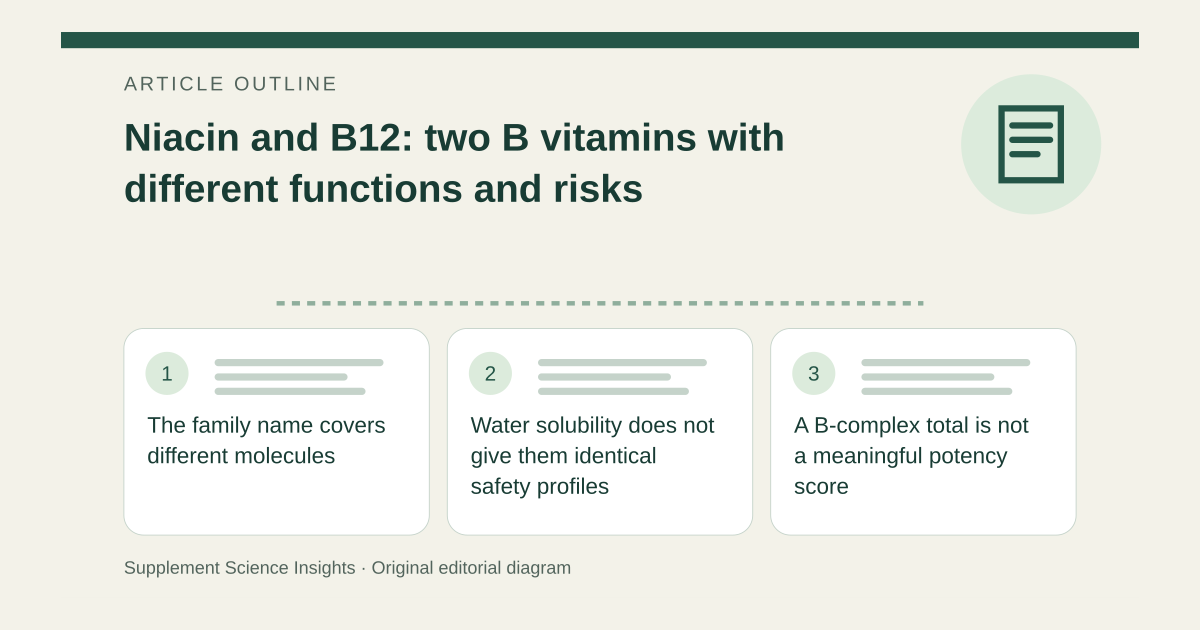
The family name covers different molecules
Niacin contributes to the coenzymes NAD and NADP, which participate in many metabolic reactions. B12 is a different nutrient involved in functions including normal red blood cell formation, DNA synthesis and nervous-system development and maintenance. [1][2]
A product containing one does not supply the other by implication. Neither nutrient’s role in metabolism establishes that extra intake provides an energy boost when nutritional needs are already met. [1][2]
Water solubility does not give them identical safety profiles
Supplemental nicotinic acid can cause flushing, and pharmacologic niacin exposures can produce more serious effects, including liver injury and impaired glucose handling. Niacinamide has a different adverse-effect profile, so even B3 form names matter. [1][2]
B12 has no established upper intake limit because of its low toxicity potential. That distinction should not be used to infer that high niacin amounts are similarly unrestricted, or that high B12 amounts are necessarily beneficial. Keep the nutrient, form, unit and purpose explicit. [1][2]
A B-complex total is not a meaningful potency score
Imagine a label lists B3 in milligrams and B12 in micrograms. Adding the printed numbers would combine different units and nutrients. Record each entry separately; a larger B3 number does not mean it replaces B12 or is the more powerful vitamin.
| Finding | Interpretation |
|---|---|
| B3 amount and form | One nutrient record |
| B12 amount and form | A different nutrient record |
| Combined potency score | Not created by adding them |
Sources for this article
- NIH ODS: Niacin
Source consulted: 2026-09-17. This is a reference resource, not a claim that we conducted the studies or tested a product. - NIH ODS: Vitamin B12
Source consulted: 2026-09-17. This is a reference resource, not a claim that we conducted the studies or tested a product.