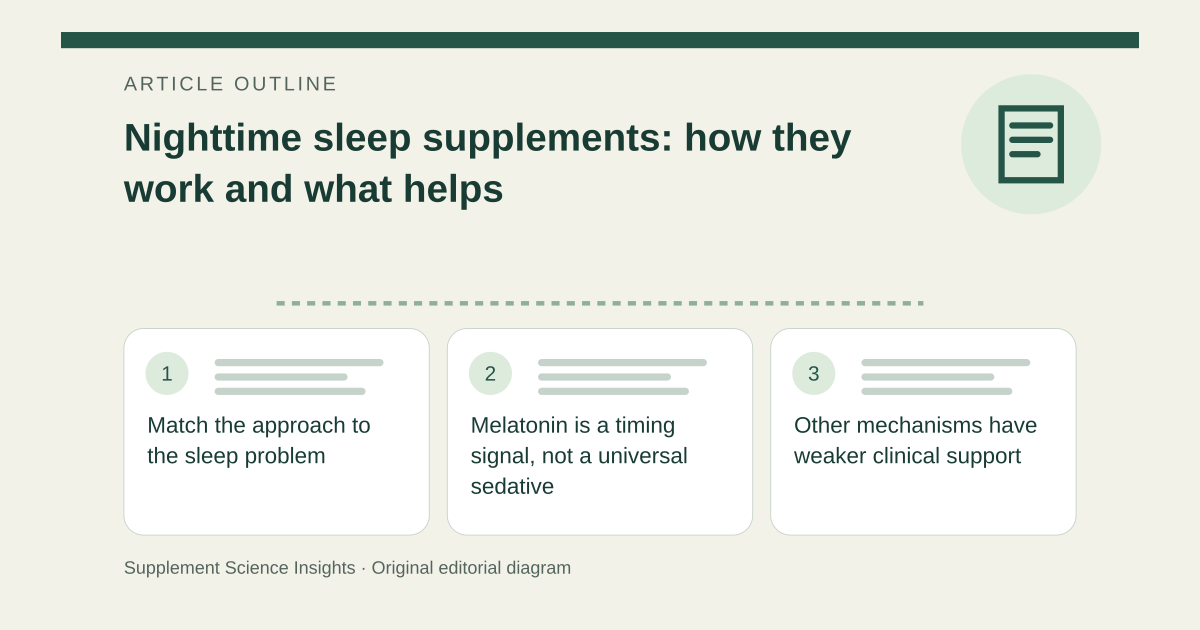
Match the approach to the sleep problem
Difficulty falling asleep, frequent waking and a shifted body clock can need different plans. NCCIH identifies CBT-I as the best-supported approach for chronic insomnia. Repeatedly adding bedtime products can miss sleep apnea, medicine effects or another cause of poor sleep. [1]
Melatonin is a timing signal, not a universal sedative
NCCIH describes possible roles for jet lag, shift-related problems and selected sleep-onset outcomes. That does not establish routine treatment of all chronic insomnia symptoms. Timing is part of its effect, so more milligrams or simply taking it later is not necessarily better. [1]
Other mechanisms have weaker clinical support
Magnesium has a normal physiological role but limited, low-quality insomnia research. Oral GABA has very limited sleep evidence and uncertain effects on human brain exposure. Combining plausible mechanisms does not demonstrate better sleep quality, duration or next-day function. [1][2]
Which sleep options do not contain melatonin?
Magnesium, glycine, L-theanine and ashwagandha are distinct ingredients, not forms of melatonin. A finished sleep blend can still combine them with melatonin, so check the complete label. Their evidence is uneven: magnesium has limited insomnia research; the glycine and L-theanine trials discussed in our related guides are small; ashwagandha sleep studies generally assessed repeated use over weeks. [4][5][6][7]
That makes a simple, clearly identified product easier to evaluate than an opaque multi-ingredient stack, but does not establish a universally best non-melatonin sleep supplement. Melatonin-free also does not mean free of sedating effects or interactions; ashwagandha can cause drowsiness. [4][5][6][7]
Falling asleep and staying asleep are different outcomes
A shorter time to fall asleep does not prove fewer awakenings or less time awake during the night. NCCIH reports a melatonin review that found a sleep-onset improvement without an improvement in time awake at night. A release-format name or a claim about feeling relaxed cannot substitute for measured sleep-maintenance evidence. [4]
For persistent difficulty staying asleep, assess the cause rather than simply adding another bedtime ingredient. Record both nights and next-day function. CBT-I has stronger guideline support for chronic insomnia than a general supplement ranking. [4]
Which supplements are least likely to leave you groggy?
The sources reviewed here do not provide a reliable comparative grogginess ranking across sleep supplements. Melatonin can cause daytime sleepiness, and ashwagandha can cause drowsiness. Small favorable next-day findings for glycine do not prove it is safer than every alternative. Product combinations, timing, amount and personal response matter; do not drive or perform hazardous work when drowsy. [8][7][5]
Evaluate sleep and daytime function together
Imagine a bedtime blend causes grogginess but nights remain fragmented. Review the product and seek assessment instead of counting sleepiness as success. Medicine interactions and uncertain long-term supplement safety matter, especially when several sedating products are combined. [1][3]
| Claim or situation | Interpretation |
|---|---|
| Shifted sleep timing | Different from chronic insomnia |
| Melatonin | Timing matters |
| GABA or magnesium | Limited outcome evidence |
| Next-day grogginess | Not proof of restorative sleep |
Sources for this article
- Sleep Disorders and Complementary Health Approaches: Usefulness and Safety | NCCIH
Source consulted: 2026-09-21. This is a reference resource, not a claim that we conducted the studies or tested a product. - Effects of Oral Gamma-Aminobutyric Acid (GABA) Administration on Stress and Sleep in Humans: A Systematic Review - PMC
Source consulted: 2026-09-21. This is a reference resource, not a claim that we conducted the studies or tested a product. - Dietary Supplements: What You Need to Know - Consumer
Source consulted: 2026-09-21. This is a reference resource, not a claim that we conducted the studies or tested a product. - NCCIH: Sleep disorders and complementary health approaches
Source consulted: 2026-09-25. This is a reference resource, not a claim that we conducted the studies or tested a product. - Bannai et al. 2012: Glycine and daytime performance during partial sleep restriction
Source consulted: 2026-09-25. This is a reference resource, not a claim that we conducted the studies or tested a product. - Hidese et al. 2019: L-theanine, stress-related symptoms and cognition, randomized crossover trial
Source consulted: 2026-09-25. This is a reference resource, not a claim that we conducted the studies or tested a product. - NIH ODS: Ashwagandha, health professional fact sheet
Source consulted: 2026-09-25. This is a reference resource, not a claim that we conducted the studies or tested a product. - NCCIH: Melatonin, what you need to know
Source consulted: 2026-09-25. This is a reference resource, not a claim that we conducted the studies or tested a product.