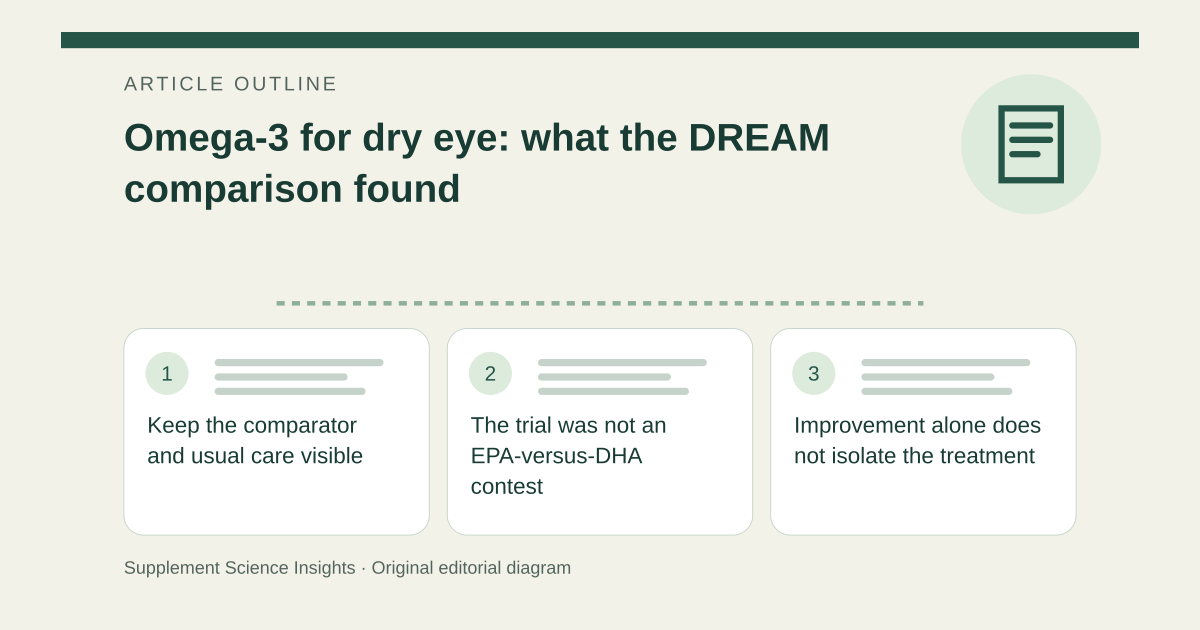
Keep the comparator and usual care visible
NIH’s report describes 535 participants assigned to 3 g daily EPA plus DHA or an olive-oil control for 12 months. Participants could continue existing dry-eye treatment. The study therefore evaluated supplementation in a setting that included usual care, rather than replacing all treatment. [1]
Symptoms improved in both groups, but the difference between groups was not statistically significant. Clinical signs also did not show an advantage. A before-and-after improvement in the omega-3 group alone would miss the comparison that answers the trial question. [1]
The trial was not an EPA-versus-DHA contest
The active preparation combined EPA and DHA. It cannot establish that one component was superior or that a different ratio would work. The NIH summary reports the trial; this article does not independently reappraise its original data. [1]
Discuss persistent dry-eye symptoms with an eye-care clinician rather than treating a supplement’s eye-health label as evidence for the exact condition or preparation. [1]
Improvement alone does not isolate the treatment
Imagine a participant improves while continuing eye drops and taking capsules. Without the comparison group, the capsule’s contribution cannot be separated from other explanations.
| Detail | Interpretation |
|---|---|
| Combined EPA and DHA | One tested intervention |
| Both groups improved | Between-group comparison matters |
| Retail ranking | Not established |
Sources for this article
- NIH/NEI: DREAM trial findings for omega-3 and dry eye
Source consulted: 2026-09-17. This is a reference resource, not a claim that we conducted the studies or tested a product.