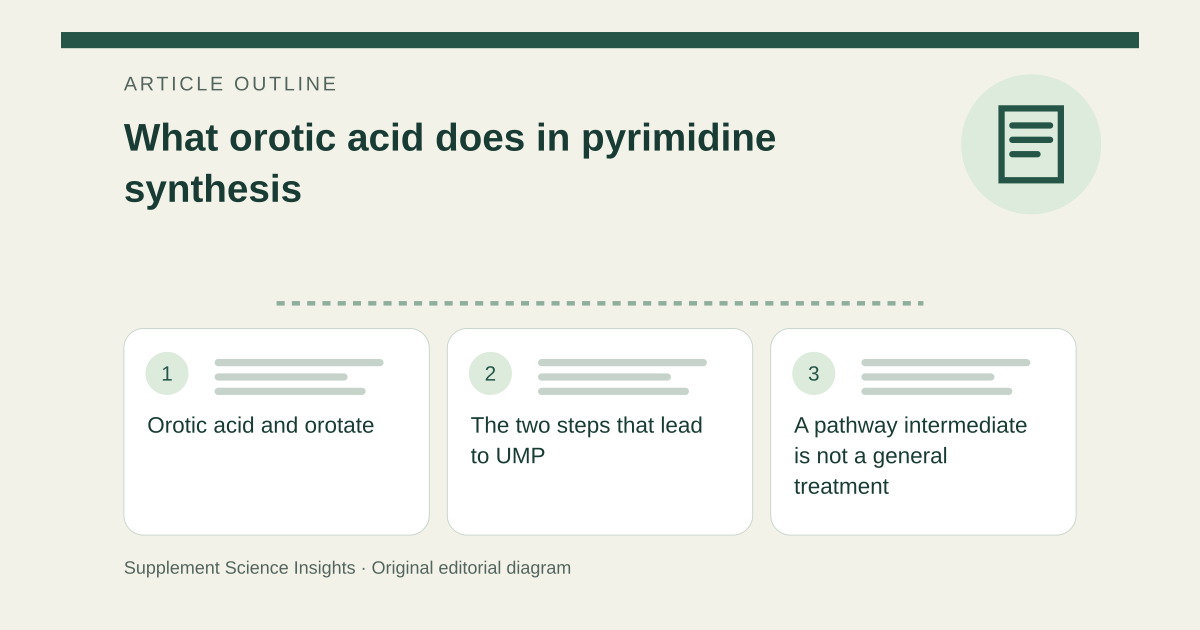
Orotic acid and orotate
Orotic acid is a small pyrimidine compound involved in nucleotide metabolism. ChEBI describes its structure as a uracil-related ring bearing a carboxyl group and gives the formula C5H4N2O4. Orotate is the corresponding deprotonated form. The two names are closely related, but a chemical record should still specify which form it describes. [1]
This identity helps interpret supplement names. In a mineral orotate, the mineral is associated with orotate; the whole compound is not simply the elemental mineral. A mineral-orotate label therefore raises both a composition question and an evidence question. The name alone cannot tell you how much mineral is supplied or whether that preparation improves a health outcome. [1]
The two steps that lead to UMP
Human UMP synthase, encoded by UMPS, carries out the last two steps of the de novo pathway to uridine monophosphate, or UMP. Its first enzyme activity converts orotate to orotidine monophosphate, abbreviated OMP. Its second enzyme activity removes a carboxyl group from OMP to produce UMP. [2]
The distinction between OMP and UMP is worth keeping: orotate does not simply become UMP in one unnamed reaction. One protein supplies two catalytic activities. UniProt’s curated human entry records both activities and their supporting research, allowing the intermediate steps to be traced rather than guessed from similar names. [2]
A pathway intermediate is not a general treatment
Variants affecting UMPS can cause hereditary orotic aciduria, a rare disorder of pyrimidine metabolism. This illustrates why the function of the enzyme matters. It does not mean that ordinary tiredness, anemia or a dietary concern can be diagnosed as an orotate problem from symptoms alone. [2][3]
Nor does participation in a biochemical pathway establish that extra orotic acid is beneficial. A supplement claim would need evidence for the actual preparation, population and outcome. The chemistry and enzyme records cited here establish identity and pathway function; they do not provide a general supplementation dose or demonstrate a health benefit from taking orotic acid. [2][3]
Reading a hypothetical pathway claim
Consider an advertisement that moves from “orotate is involved in UMP synthesis” to “this capsule boosts your performance.” The first statement identifies a biochemical role. The second requires an intervention study measuring performance in people using the capsule’s preparation. An arrow on a metabolic diagram cannot supply that missing comparison. Start by separating the established pathway from the proposed effect of adding more material to it. [2][3]
| Stage | What happens |
|---|---|
| Orotate to OMP | Orotate phosphoribosyltransferase activity of UMP synthase |
| OMP to UMP | OMP decarboxylase activity of the same protein |
| Supplement to performance claim | Requires additional human outcome evidence |
Sources for this article
- orotic acid (CHEBI:16742)
Source consulted: 2026-09-20. This is a reference resource, not a claim that we conducted the studies or tested a product. - UniProtKB P11172: human uridine monophosphate synthase
Source consulted: 2026-09-20. This is a reference resource, not a claim that we conducted the studies or tested a product. - Dietary Supplements: What You Need to Know - Consumer
Source consulted: 2026-09-20. This is a reference resource, not a claim that we conducted the studies or tested a product.