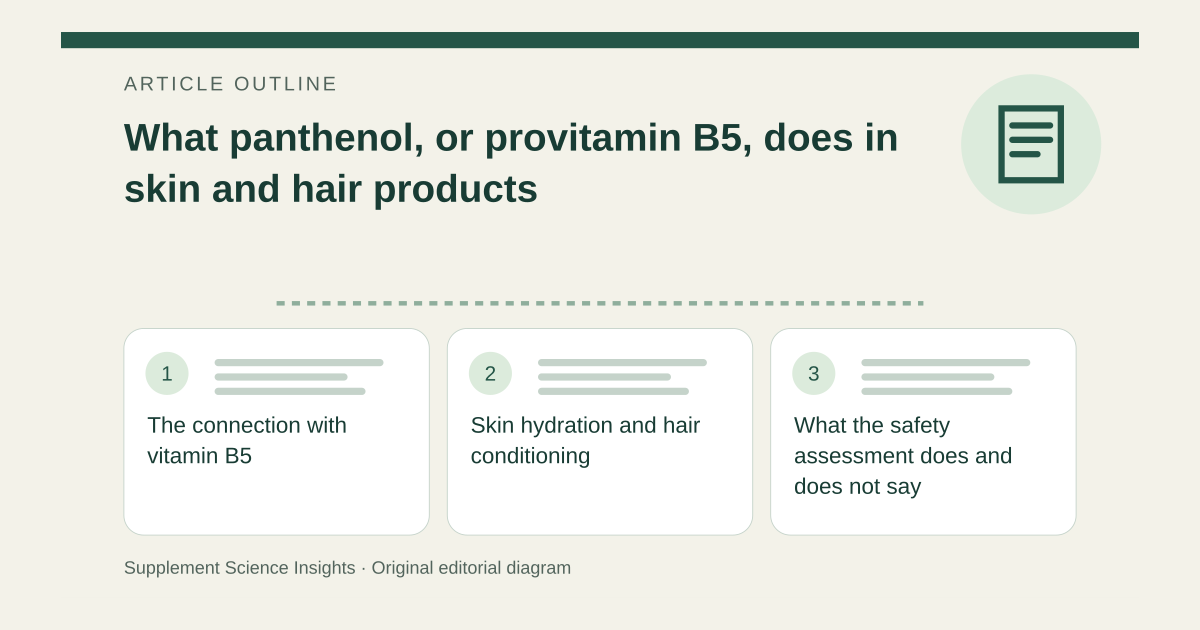
The connection with vitamin B5
Panthenol is the alcohol analogue of pantothenic acid, vitamin B5. It is often called provitamin B5 because of its relationship to the vitamin. The names are related, but panthenol in a conditioner and pantothenic acid as a dietary nutrient are not interchangeable uses. [1][2]
The molecular identity also differs from a whole finished cosmetic. A cream containing panthenol includes a formulation around it, and that formulation influences the product's texture and use. Recognizing an ingredient does not establish the amount delivered or the result a particular product will produce. [1][2]
Skin hydration and hair conditioning
The Cosmetic Ingredient Review final assessment lists panthenol as a skin-conditioning humectant, a hair-conditioning agent and a solvent. A humectant is used to help retain moisture. Hair conditioning concerns the properties and feel of the hair; it is a different claim from stimulating new follicles or reversing hair loss. [2]
These functions explain why panthenol appears in skin and hair formulations. They do not prove that every panthenol product has the same effect, or that more panthenol necessarily produces a better result. A rinse-off product and a leave-on product also have different patterns of exposure. [2]
What the safety assessment does and does not say
The panel concluded that the reviewed ingredients were safe under the practices and concentrations described in its assessment. That is a scoped cosmetic safety conclusion, not a declaration that any concentration, route or homemade formulation is safe. It is also not a clinical efficacy finding for hair growth or a skin disease. [2]
The assessment includes irritation and sensitization information among several lines of evidence. Individual intolerance remains possible even when an ingredient has an acceptable safety profile for its intended cosmetic use. If a product causes persistent irritation, discontinue it and consider professional evaluation rather than assuming the vitamin-related name rules out a reaction. [2]
Interpreting a hypothetical shampoo claim
Suppose a shampoo advertises “provitamin B5 conditioning.” That wording is consistent with a cosmetic conditioning role. It does not establish that the shampoo corrects dietary B5 deficiency or treats a cause of hair loss. Those are separate outcomes requiring different evidence. [2]
| Claim | Evidence needed |
|---|---|
| Contains panthenol | Ingredient identity |
| Improves conditioning in this formula | Finished-product performance evidence |
| Regrows lost hair | Clinical evidence for that distinct outcome |
Sources for this article
- pantothenol (CHEBI:27373)
Source consulted: 2026-09-20. This is a reference resource, not a claim that we conducted the studies or tested a product. - CIR Final Safety Assessment — Panthenol and related ingredients (2018)
Source consulted: 2026-09-20. This is a reference resource, not a claim that we conducted the studies or tested a product.