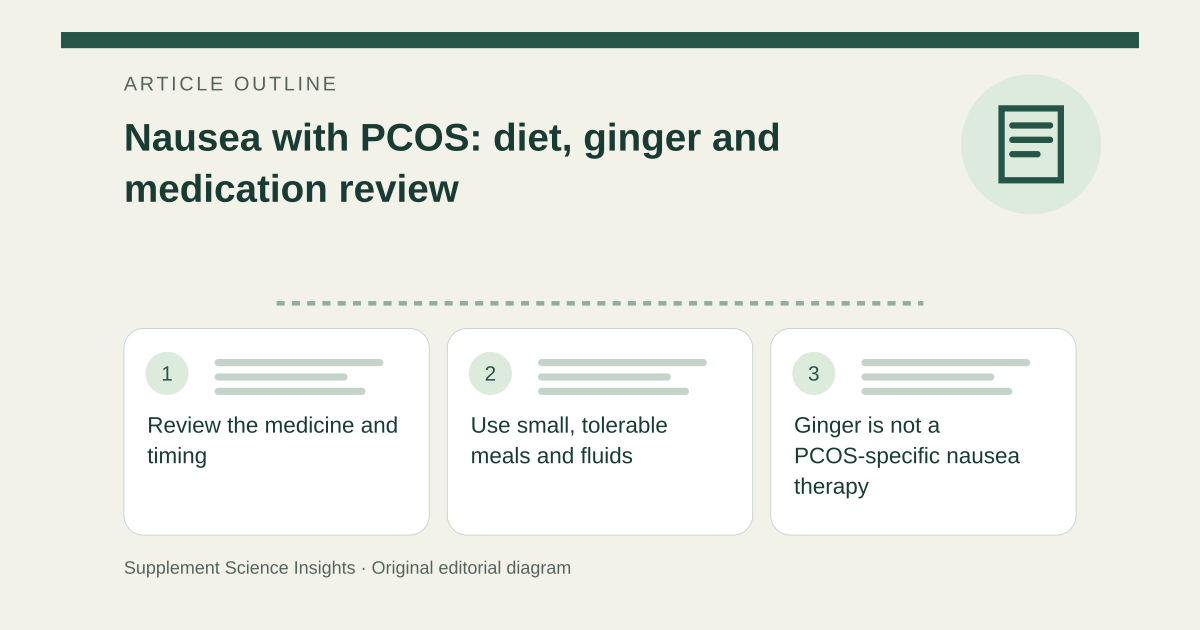
Review the medicine and timing
Metformin is used in some PCOS care plans, and NHS lists nausea, vomiting, diarrhea and abdominal discomfort among its common adverse effects. Report persistent problems to the prescriber or pharmacist; do not simply add several supplements or stop treatment without advice. [1][2]
Use small, tolerable meals and fluids
NHS nausea guidance suggests small regular meals and sips rather than large difficult meals. Note whether symptoms relate to a new medicine, missed meals, a particular food or possible pregnancy. Those patterns guide the next assessment better than the PCOS label alone. [3]
Ginger is not a PCOS-specific nausea therapy
NCCIH reports possible benefit for pregnancy nausea but different findings in other settings, mostly using supplements. A mild tea may be tolerated; concentrated products can cause heartburn or abdominal discomfort and need medication review. [4][5]
Escalate significant or unusual symptoms
Imagine nausea after a medicine change progresses to repeated vomiting or breathing problems. Seek urgent assessment rather than treating it as expected PCOS discomfort. NHS specifically warns about rare serious metformin reactions with systemic symptoms. [2]
| Clue | Relevant next step |
|---|---|
| New medicine | Prescriber/pharmacist review |
| Small sips tolerated | Maintain fluids |
| Possible pregnancy | Appropriate assessment |
| Severe systemic symptoms | Urgent care |
Sources for this article
- Polyendocrine metabolic ovarian syndrome (PMOS) - NHS
Source consulted: 2026-09-21. This is a reference resource, not a claim that we conducted the studies or tested a product. - Metformin: a medicine to treat type 2 diabetes - NHS
Source consulted: 2026-09-21. This is a reference resource, not a claim that we conducted the studies or tested a product. - Feeling sick (nausea) - NHS
Source consulted: 2026-09-21. This is a reference resource, not a claim that we conducted the studies or tested a product. - Ginger: Usefulness and Safety | NCCIH
Source consulted: 2026-09-21. This is a reference resource, not a claim that we conducted the studies or tested a product. - Ginger | Memorial Sloan Kettering Cancer Center
Source consulted: 2026-09-21. This is a reference resource, not a claim that we conducted the studies or tested a product.