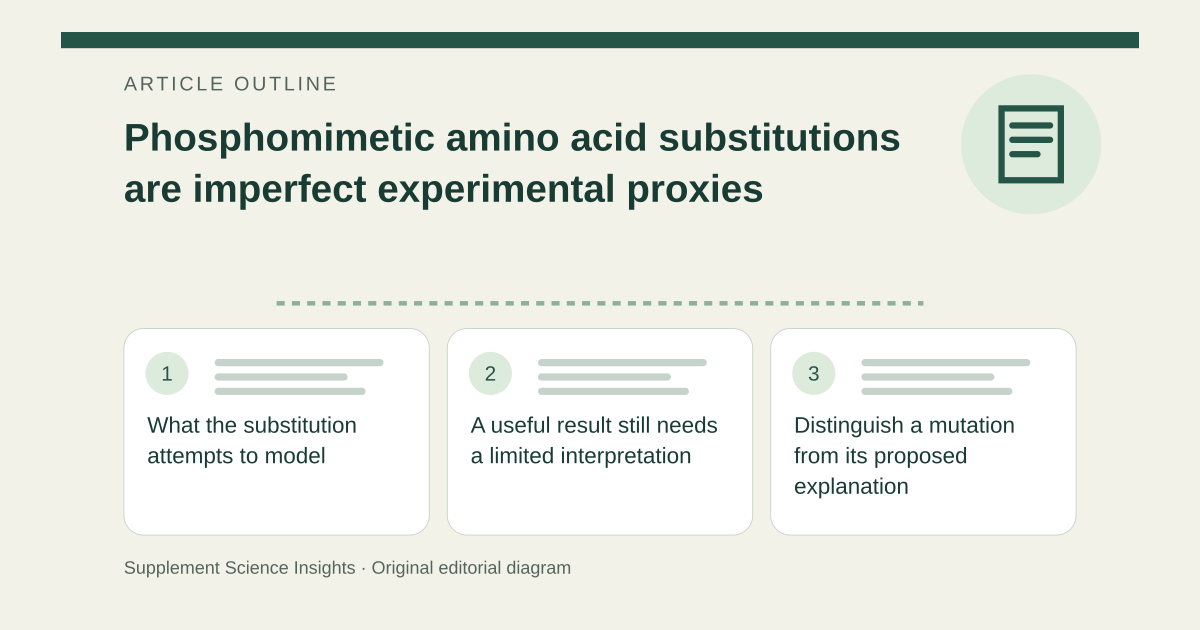
What the substitution attempts to model
Researchers commonly replace serine or threonine with aspartate or glutamate to introduce negative charge. These substitutions can help investigate whether local charge contributes to a protein’s behavior. [1]
A substituted side chain differs from a phosphorylated residue in geometry and charge. A partner that recognizes a phosphate-bearing site may fail to recognize the substitute. [1]
A useful result still needs a limited interpretation
An altered activity supports a conclusion about the tested mutant under those conditions. It does not automatically establish the effect of reversible phosphorylation in the original protein. [1]
Use the term phosphomimetic as an experimental intention rather than a guarantee of faithful mimicry. Compare the actual modified protein where that comparison is needed. [1]
Distinguish a mutation from its proposed explanation
Imagine a serine-to-aspartate mutant changes binding. The result establishes altered binding for that mutant; calling it permanently phosphorylated would overstate what was tested.
| Detail | Interpretation |
|---|---|
| Substitution | Introduces a different side chain |
| Phosphate recognition | May not be reproduced |
| Conclusion | Limited to the tested comparison |
Sources for this article
- Mapping and analysis of phosphorylation sites: a quick guide for cell biologists - PMC
Source consulted: 2026-09-18. This is a reference resource, not a claim that we conducted the studies or tested a product.