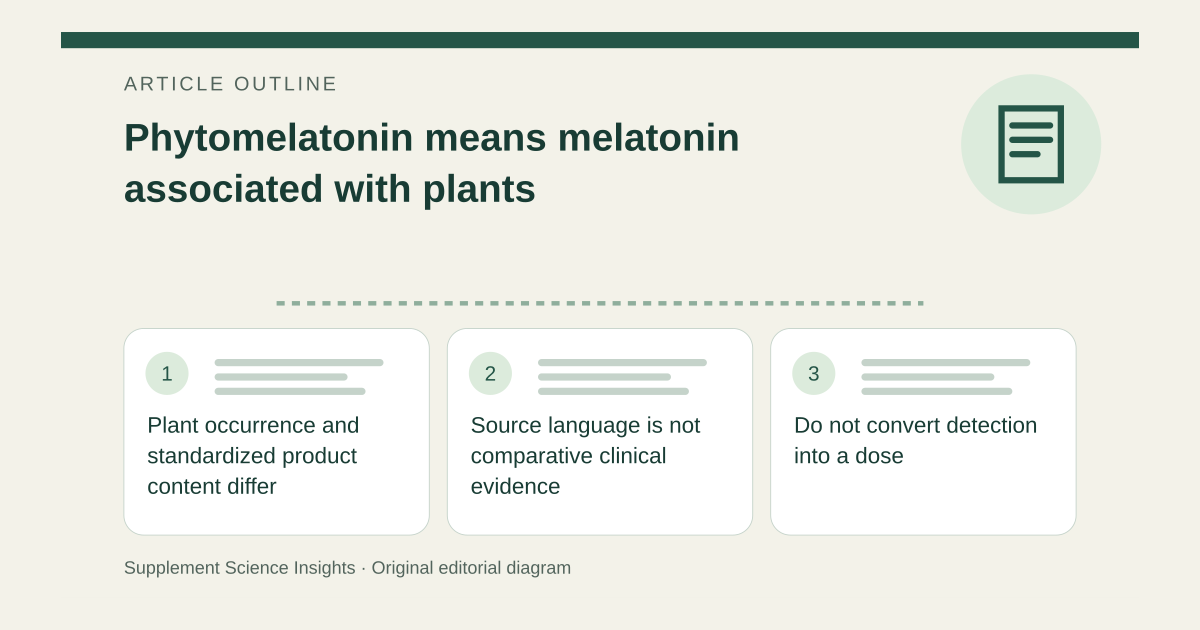
Plant occurrence and standardized product content differ
The cited review describes melatonin in plant species and tissues and compares plant and animal biosynthetic pathways. Detecting the molecule in a plant does not establish a uniform amount in every food portion or extract. [1]
A finished preparation still needs a measured composition. The plant name alone cannot supply the melatonin quantity missing from a product description. [1]
Source language is not comparative clinical evidence
Calling an ingredient plant-derived does not establish superior sleep outcomes, absence of adverse effects or equivalence to a studied preparation. Those are separate questions. [1]
This page uses the review for identity and occurrence, not as proof of a consumer product’s clinical benefit. Amount, other constituents and the evidence for the proposed use remain relevant. [1]
Do not convert detection into a dose
Imagine a fruit contains detectable melatonin. That fact alone does not show that a serving delivers the amount or effect of a particular studied preparation.
| Detail | Interpretation |
|---|---|
| Phyto prefix | Plant context |
| Detected compound | Not a standardized dose |
| Comparative benefit | Requires clinical evidence |
Sources for this article
- Melatonin and Phytomelatonin: Chemistry, Biosynthesis, Metabolism, Distribution and Bioactivity in Plants and Animals-An Overview - PubMed
Source consulted: 2026-09-18. This is a reference resource, not a claim that we conducted the studies or tested a product.