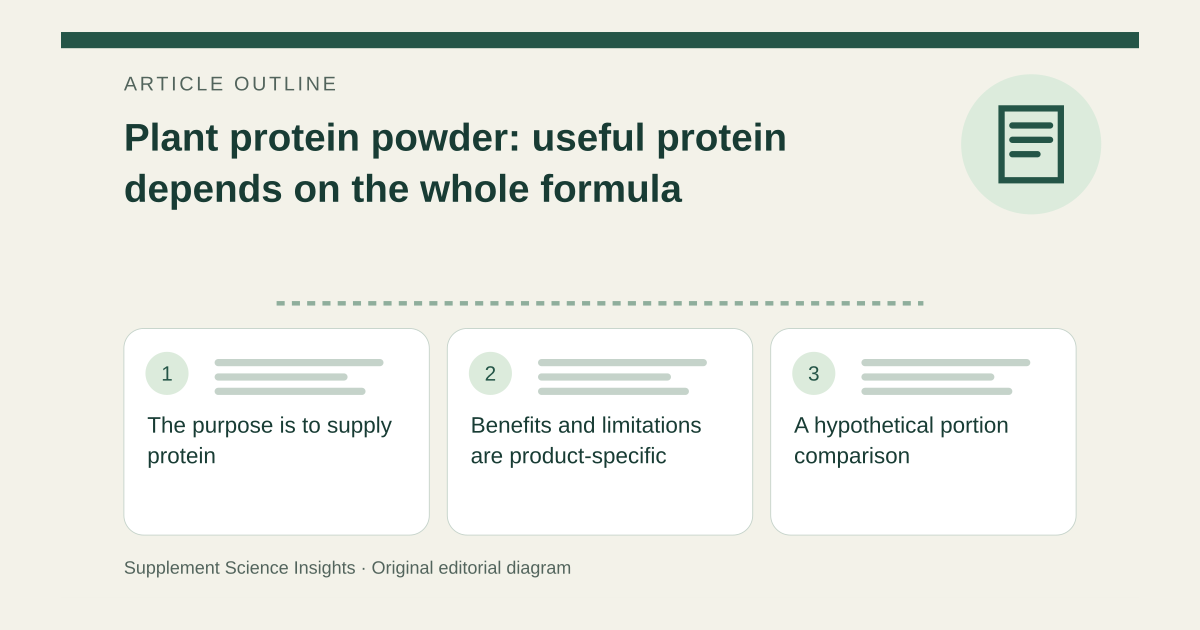
The purpose is to supply protein
NIH ODS describes the importance of protein quantity and essential amino-acid quality for exercise recovery and adaptation. A plant powder can contribute toward those needs. A blend’s usefulness depends on its actual protein amount and composition, not simply the number of plants pictured on the package. [1]
Benefits and limitations are product-specific
Convenience and a nonmilk protein source may be practical advantages. They do not establish that every plant powder is superior, better tolerated or safer than every milk-based powder. A full formula can include sweeteners and other ingredients; consider allergies, dietary restrictions and whether the powder is needed at all. Sports certification can address defined testing criteria, but does not prove a muscle-growth benefit. [1][2]
A hypothetical portion comparison
Imagine one plant powder supplies18 g protein in a30 g serving and another supplies24 g in a30 g serving. The second provides more protein for that mass, but the calculation leaves amino-acid quality and tolerability unresolved. If an individual requires an extra18 g, a larger number on a tub does not automatically make it a better fit. [3][1]
| Hypothetical plant powder | 30 g powder supplies |
|---|---|
| A | 18 g protein |
| B | 24 g protein |
Sources for this article
- Dietary Supplements for Exercise and Athletic Performance - Health Professional Fact Sheet
Source consulted: 2026-09-20. This is a reference resource, not a claim that we conducted the studies or tested a product. - Definition & Facts for Lactose Intolerance - NIDDK
Source consulted: 2026-09-20. This is a reference resource, not a claim that we conducted the studies or tested a product. - How to Understand and Use the Nutrition Facts Label | FDA
Source consulted: 2026-09-20. This is a reference resource, not a claim that we conducted the studies or tested a product.