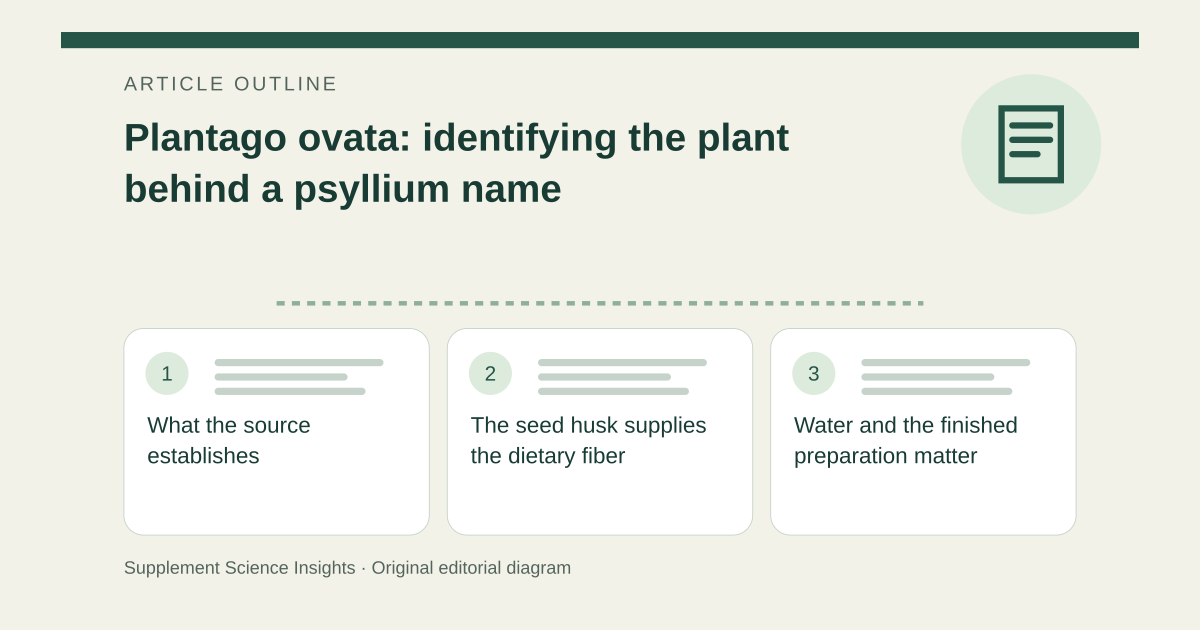
What the source establishes
Kew describes a native range spanning several dry regions and links detailed regional floras. The Flora of Iraq account describes narrow leaves, dense flower spikes and two-seeded capsules. [1]
Regional accounts record habitat and flowering periods in their own locations. Those observations describe plants in context; they do not provide one universal home-growing calendar. [1]
The seed husk supplies the dietary fiber
Ispaghula husk is the seed coat of Plantago ovata, rather than its leaves or roots. The European Medicines Agency distinguishes the husk from the whole seed and describes preparations made by powdering the seed coats. A species name alone therefore does not tell you which plant part a product contains. [2]
The husk contains fiber that takes up water and forms a gel-like mass. This increases stool water and bulk, helping stool pass during constipation. The mechanism explains a physical fiber function; it does not establish every additional health claim attached to a supplement. [2]
Water and the finished preparation matter
Follow the finished product’s directions for fluid and use. MedlinePlus specifies at least 8 ounces (240 mL) of liquid when taking psyllium and advises discussing swallowing difficulty, intestinal blockage and medicines with a clinician or pharmacist. Its swelling behavior is a reason to use the preparation correctly, not to swallow dry powder or infer a dose from the plant name. [3]
What it does not establish
A species name cannot establish a product’s processing, purity, fiber amount or clinical effect. Botanical descriptions also should not serve as the sole basis for collecting an unfamiliar plant for consumption. This page concerns identification records rather than treatment evidence. [1]
A hypothetical distinction
Imagine a label correctly names a species. The identity still leaves the harvested plant part, processing and finished-product composition to be documented.
| Detail | Interpretation |
|---|---|
| Species | Botanical identity |
| Regional flora | Location-specific observations |
| Finished fiber product | Additional evidence needed |
Sources for this article
- Plantago ovata Forssk. | Plants of the World Online | Kew Science
Source consulted: 2026-09-19. This is a reference resource, not a claim that we conducted the studies or tested a product. - European Medicines Agency — Ispaghula husk
Source consulted: 2026-09-20. This is a reference resource, not a claim that we conducted the studies or tested a product. - MedlinePlus — Psyllium
Source consulted: 2026-09-20. This is a reference resource, not a claim that we conducted the studies or tested a product.