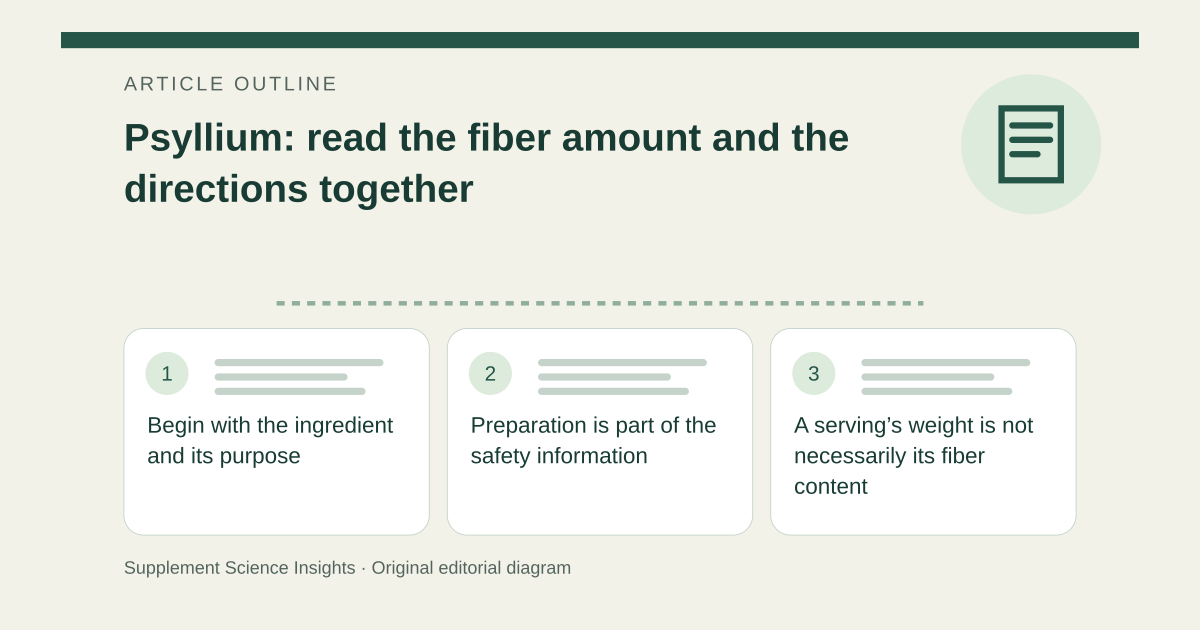
Begin with the ingredient and its purpose
Psyllium is used as a bulk-forming laxative: it absorbs liquid and increases stool bulk. It is sold in several formats, including powders and capsules. The practical question is therefore more specific than whether a container says “fiber”: what does this exact preparation contain, and what directions accompany it? [1]
This page explains how to organize that information. It does not compare retail products, establish a treatment plan or estimate how much a person’s cholesterol or symptoms would change. [1]
Preparation is part of the safety information
The inspected DailyMed label warns that inadequate fluid can allow psyllium to swell and obstruct the throat or esophagus. It also warns against use with swallowing difficulty. Follow the exact product’s liquid and preparation directions; a dry powder is not something to swallow by itself. [2][1]
Seek immediate medical help for difficulty breathing or swallowing after taking it. Rectal bleeding, persistent constipation, abdominal pain or a history of intestinal blockage require medical assessment rather than simply adding more fiber. [2][1]
A serving’s weight is not necessarily its fiber content
Consider an invented powder label with a 5 g serving and 3 g of dietary fiber. The fiber amount is 3 g, not 5 g. The example supplies no basis for deciding what the other 2 g contains; that requires the actual ingredient list.
A second fictional preparation might use four capsules per serving. Counting capsules cannot establish that its fiber amount matches the powder. Copy the disclosed quantity and serving unit together before comparing them. None of these example quantities is a dose recommendation.
| Field | Stated quantity | Interpretation |
|---|---|---|
| Serving mass | 5 g | All material in one serving |
| Dietary fiber | 3 g | Declared fiber within that serving |
| Remaining material | 2 g by subtraction | Composition not established by these numbers |
Make a comparison sheet with explicit blanks
Record the full product name, form, labeled serving, declared dietary fiber, other ingredients, mixing directions and warnings. If a field is missing from the photograph you inspected, write “not visible” rather than borrowing it from another flavor or package.
Keep product directions attached to their source. A capsule count from one label and liquid instructions from another do not form a verified set of directions. This is especially important when a manufacturer sells several strengths or combinations.
Bring medicine questions to a pharmacist
Psyllium can affect the use of other medicines. MedlinePlus identifies particular interactions, while individual labels may give more general separation instructions. Ask a pharmacist about the complete medicine list instead of treating one timing interval as sufficient for every drug. [1]
Also discuss allergies and relevant medical conditions before use. The exact product, its ingredients and the reason for considering it are more useful for that conversation than a general question about whether all fiber is safe. [1]
What the evidence here establishes
The sources below explain medication use and label safety. They are not a head-to-head product trial or a new review of every health claim made for psyllium. The named label is included to make the safety wording traceable, not to recommend that brand.
A defensible reading note can be short: “The serving weighs 5 g; the fictional label declares 3 g fiber; preparation and suitability require the actual directions.” Leave clinical outcomes unresolved until the relevant evidence has been assessed.
Sources for this article
- MedlinePlus / ASHP — Psyllium
Source consulted: 2026-09-17. This is a reference resource, not a claim that we conducted the studies or tested a product. - DailyMed — Metamucil Therapy for Regularity label, version 21
Source consulted: 2026-09-17. This is a reference resource, not a claim that we conducted the studies or tested a product.
Considering a supplement?
Ingredient evidence alone does not establish which retail product is suitable. The featured option illustrates the label and formulation context above; it is not a clinical efficacy ranking.
Compare psyllium formulations (retail checks pending) → No overall winner
Compare formulations → · How we select products