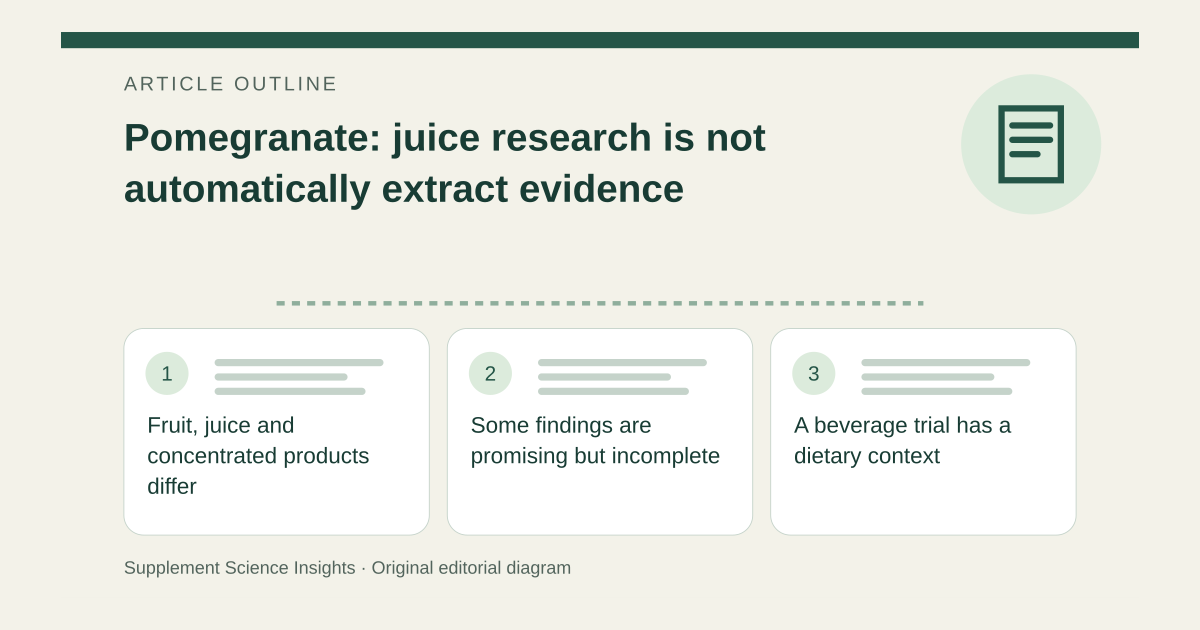
Fruit, juice and concentrated products differ
Pomegranate, Punica granatum, is consumed as food and sold in juice and extract products. Research has often used juice rather than capsules. A fruit serving, a measured beverage and a concentrated extract can differ in composition and accompanying nutrients. [1]
Other plant parts also require separate consideration. Root, stem and peel preparations should not be treated as equivalent to ordinary fruit or juice. The plant name is the start of identification, not evidence that all materials are suitable to consume. [1]
Some findings are promising but incomplete
NCCIH reports that pomegranate juice or extract may reduce blood pressure, with additional research needed to confirm the effect. Small glucose changes have also been observed. Research has not demonstrated clear effects across cholesterol and other lipid measures. [1]
These are distinct metabolic outcomes. A favorable result for one does not establish improvement in the others, prevention of cardiovascular events or a reason to change prescribed treatment. Evidence is insufficient for confident conclusions about many other promoted uses. [1]
A beverage trial has a dietary context
When reading a juice study, examine the comparison beverage, total intake and other dietary changes. If the groups consume different calories or follow different programs, those differences matter to interpretation.
A capsule cannot be declared equivalent simply by listing a fruit-equivalent quantity. Extraction changes which components are present, and an equivalence claim needs more than a mass conversion. Likewise, an antioxidant number from a laboratory assay cannot establish the size of a blood-pressure or glucose effect in people.
Food experience does not cover every plant part
Pomegranate juice is generally considered safe, and extracts may also be tolerated, but digestive symptoms and allergic reactions can occur. Root, stem and peel can contain harmful substances when consumed in large amounts. [1]
Pregnancy and breastfeeding experience with juice does not establish safety for every extract or plant part. If a product is being considered alongside treatment for blood pressure or glucose, discuss the full preparation and current care with a clinician. This reference does not supply instructions for changing medication. [1]
Do not convert fruit-equivalent mass into a clinical dose
Imagine a fictional capsule lists 500 mg extract and says it is equivalent to 5 g fruit. A study using a specified volume of juice cannot be reproduced from those numbers alone. The extraction, composition and beverage details remain missing.
The ratio describes a manufacturing claim, not established matching exposure. It does not show that the capsule delivers the study's effect or that a larger ratio means greater benefit.
| Fictional declaration | What remains unresolved |
|---|---|
| 500 mg extract; 5 g fruit equivalent | Composition and exposure |
| Juice used in a trial | Not reproduced by ratio alone |
| Larger extraction ratio | Not a clinical-benefit ranking |
Keep a food choice separate from a treatment promise
Pomegranate can be selected as a food without a clinical claim. For supplements, focus on the exact preparation and outcome rather than a broad antioxidant story. This overview does not recommend pomegranate as a cardiovascular or diabetes treatment.
Sources for this article
- NCCIH — Pomegranate: Usefulness and Safety
Source consulted: 2026-09-17. This is a reference resource, not a claim that we conducted the studies or tested a product.