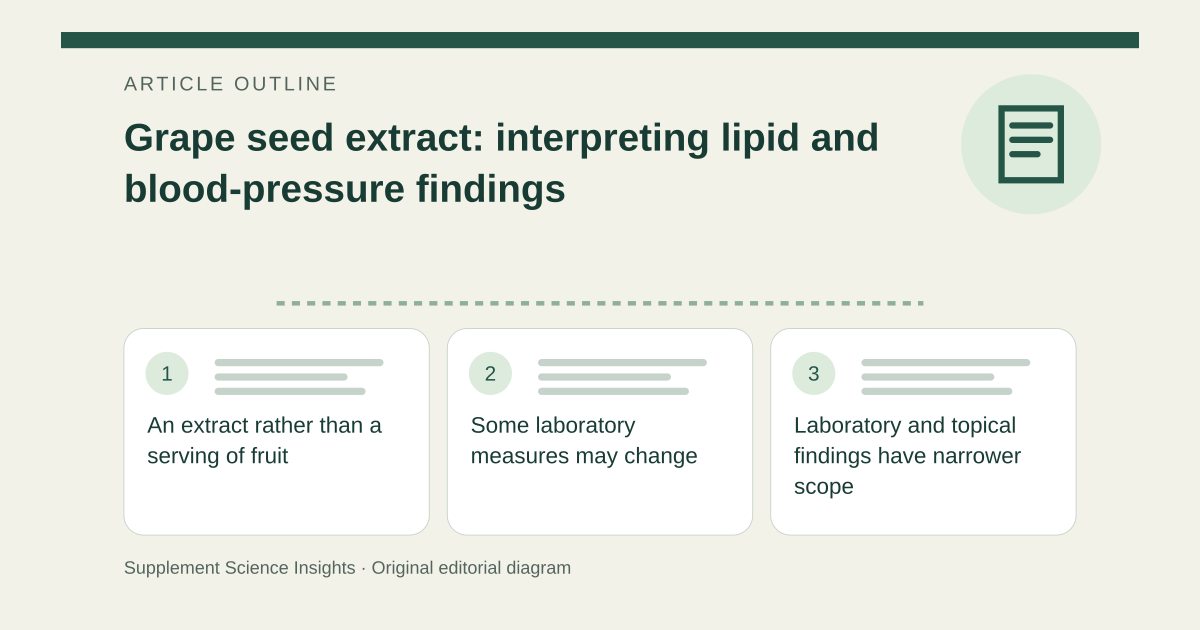
An extract rather than a serving of fruit
Grape seed extract is a concentrated preparation from grape seeds. It is different from eating grapes, using grape seed oil or taking resveratrol. Those products may share a botanical association while containing materially different components. [1]
The composition of extracts can also vary. A study's preparation should remain attached to its result rather than being replaced by a broad retail category. A front-label antioxidant claim does not identify a tested clinical outcome. [1]
Some laboratory measures may change
NCCIH describes reviews suggesting possible changes in LDL cholesterol and triglycerides, but not consistently across every lipid measure. Small studies and differences in product composition limit certainty. A favorable finding for one measure should not be reported as improvement in the entire lipid profile. [1]
Blood-pressure research has also been inconsistent. A summarized review found a diastolic change without a clear systolic change, with differences among individual studies. These findings do not establish fewer cardiovascular events or a replacement for prescribed treatment. [1]
Laboratory and topical findings have narrower scope
Experimental work has explored wound healing and dental applications, but human evidence is too limited for confident conclusions. A laboratory mouth-rinse result does not establish that swallowing an extract prevents tooth decay. [1]
Likewise, a topical preparation and an oral capsule require separate assessments. Route, concentration and clinical setting affect what a result means. A reference should state whether the finding came from people or an experimental model instead of allowing a biological explanation to imply a demonstrated patient benefit. [1]
General tolerability leaves important unknowns
Grape seed extract is generally described as well tolerated in oral and topical research. That does not establish safety for every formulation, duration or combination with medicines. Review the full product and treatment list with a clinician or pharmacist. [1]
Pregnancy and breastfeeding information is limited. An absence of strong safety data should remain an uncertainty, not be rewritten as evidence of safety. Products combining multiple botanicals also require assessment of the complete formula rather than this ingredient in isolation. [1]
Report both numbers in a pressure reading
Imagine a hypothetical study finds average diastolic pressure falling by 3 mmHg compared with placebo while systolic pressure is unchanged. A precise account reports the lower-number result and the unchanged upper number.
It should not claim that heart-attack risk fell unless events were measured. Nor should the fictional result be used to reduce a medicine dose. The example shows why two related measurements still require separate reporting.
| Hypothetical outcome | Accurate interpretation |
|---|---|
| Diastolic: −3 mmHg versus placebo | Specific lower-number change |
| Systolic: unchanged | Report separately |
| Events not measured | No event-prevention claim |
A biomarker result is useful within its limits
The most informative comparison preserves the extract, population, duration and specific measurement. This overview explains the evidence without ranking antioxidant strength or recommending a cardiovascular supplement. Clinical-event claims need clinical-event evidence.
Sources for this article
- NCCIH — Grape seed extract: Usefulness and Safety
Source consulted: 2026-09-17. This is a reference resource, not a claim that we conducted the studies or tested a product.