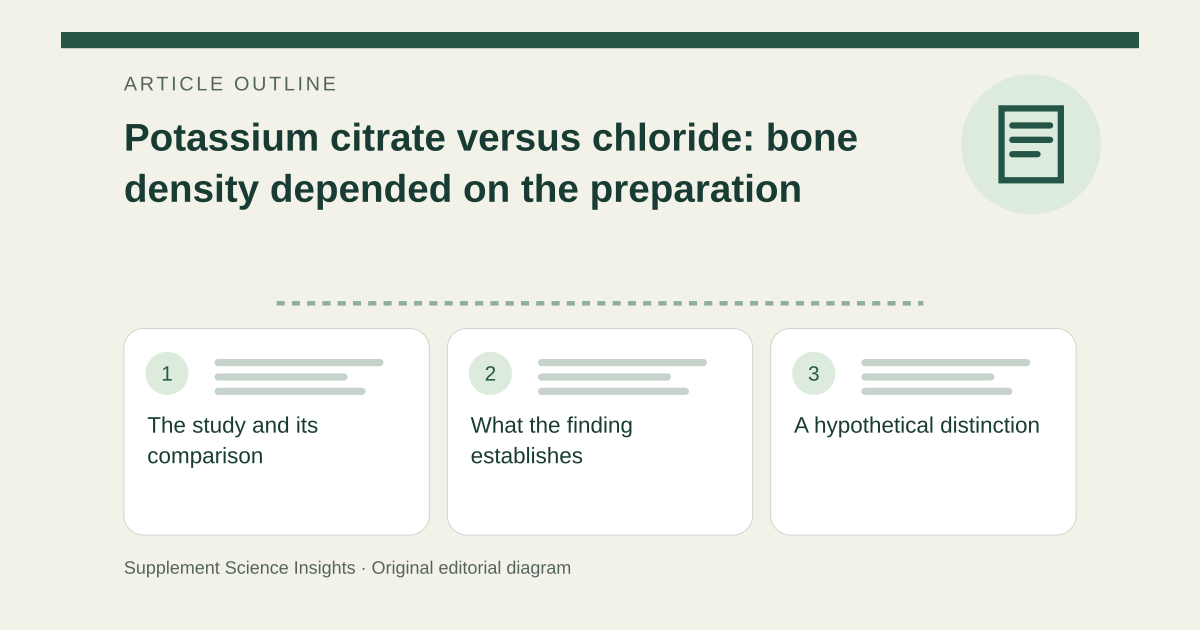
The study and its comparison
A blinded trial randomized 161 postmenopausal women with low bone mass to equal potassium amounts supplied as citrate or chloride. The primary outcome was lumbar-spine bone-density change after twelve months. [1]
The citrate group had a favorable between-group difference at the spine and selected hip sites. The spine difference was about 1.87 percent. Differences at the distal radius and for total-body density were not significant. [1]
What the finding establishes
Because both groups received potassium, this is not evidence that simply adding potassium explains the result. The study measured density rather than fracture prevention, and effects varied by skeletal site. Funding and conflicts were not established from the abstract. Neither this comparison nor an acid-base hypothesis identifies a universally suitable supplement. [1]
A hypothetical distinction
Imagine two salts supply equal potassium but produce different outcomes. Their accompanying compounds remain part of the intervention.
| Detail | Interpretation |
|---|---|
| Measured outcome | Keep the endpoint specific |
| Study preparation | Not every retail product |
| Remaining uncertainty | Not resolved by a mechanism |
Sources for this article
- Partial neutralization of the acidogenic Western diet with potassium citrate increases bone mass in postmenopausal women with osteopenia.
Source consulted: 2026-09-19. This is a reference resource, not a claim that we conducted the studies or tested a product.